
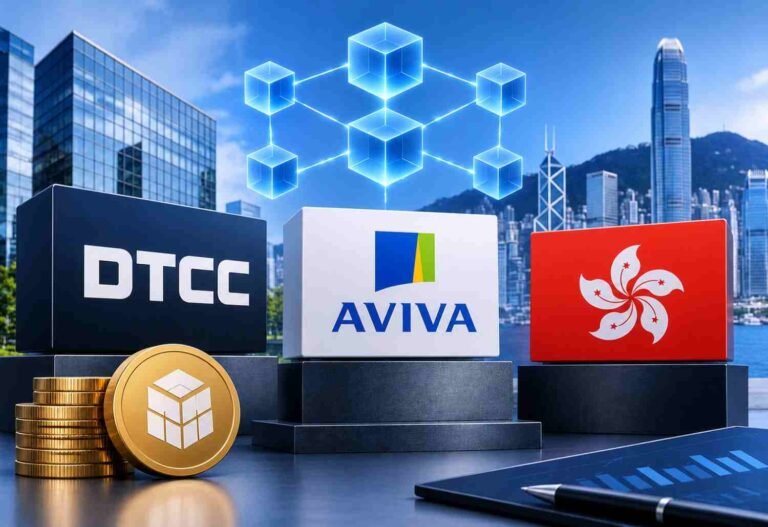
DTCC launched its tokenization service, Aviva put a £22 billion fund on the XRP Ledger, and Hong Kong approved 24/7 fund trading and a Solana stablecoin plan.
Traditional finance had another busy week on the blockchain front. DTCC launched its tokenization service, the Bank of England opened a consultation on tokenized collateral, and Aviva Investors brought a second fund onto the XRP Ledger. Hong Kong added two developments of its own: round-the-clock trading for tokenized money market funds, and a planned stablecoin integration with Solana.
DTCC Launches Tokenization Service for Traditional Securities
The Depository Trust & Clearing Corporation (DTCC) officially launched its Tokenization Service this week. It lets eligible users create digital representations of traditional securities, while the underlying assets stay in DTCC’s existing custody infrastructure.
The Depository Trust Company (DTC), a DTCC subsidiary, runs the service. Financial institutions can convert eligible securities into tokenized form and move back to the traditional form through supported processes. Investors can also transfer eligible tokenized securities into digital wallets, which could open up new liquidity options and make collateral easier to manage.
Tokenization doesn’t change what investors own. Tokenized securities carry the same ownership rights, investor protections and economic benefits as their traditional counterparts.
Scale is what makes this launch significant. DTCC says its infrastructure holds more than $114 trillion in assets, and 20 major financial institutions have already signed up. Wider adoption will still depend on how the rollout goes and how many market participants join.
Until now, most tokenization projects ran on separate platforms with limited market support. DTCC is bringing tokenized securities into the core of existing market infrastructure, which could mean faster asset transfers and quicker collateral movements.
Bank of England Explores Tokenized Collateral
The Bank of England opened a consultation on tokenized collateral in central clearing. It focuses on central counterparties (CCPs), the organizations that manage risk between firms during market transactions and require collateral to cover potential losses.
Read more: Bank of England Opens Consultation on Tokenized Collateral Rules – Ledger Tribune
Under the proposal, CCPs could accept tokenized forms of eligible collateral. That might help firms move assets and meet margin requirements faster, and blockchain technology could improve collateral management across jurisdictions.
The Bank says existing rules don’t automatically block tokenized collateral. But tokenized assets must meet the same standards as traditional ones. Firms must be able to value and transfer collateral when needed and convert it into usable value during market stress. Tokenization can’t weaken those protections.
The consultation also includes a proposed supervisory statement explaining how the Bank would assess applications involving tokenized collateral. Sarah Breeden, Deputy Governor for Financial Stability, said the initiative supports innovation while protecting financial stability, and described it as part of wider work with authorities and financial institutions.
Collateral is often still handled through older systems and processes, which can cause delays. Tokenization could speed things up, though the approach still needs regulatory oversight, and firms will have to show their arrangements meet existing safety requirements.
Aviva Investors Brings Its £22 Billion Fund to XRP Ledger
Aviva Investors launched a tokenized share class for its Sterling Liquidity Fund, which manages about £22 billion in assets. The share class runs on the XRP Ledger, Ripple’s blockchain network, and was built in partnership with Ripple. It starts with an initial £50 million investment.
It’s the second existing Aviva fund to be tokenized. The first was a tokenized share class of the USD Liquidity Fund, launched in July 2026. Aviva now ranks among Europe’s largest tokenized money market fund providers.
Money market funds invest in short-term instruments and help investors manage cash while seeking relatively stable returns. The tokenized share class stays tied to the underlying fund, so its investment purpose doesn’t change. Tokenization simply offers another way to represent and manage fund shares.
The launch also strengthens Ripple’s position in institutional markets, where it has been building payments and asset tokenization products.
Hong Kong Expands Tokenized Fund Trading and Stablecoin Access
Hong Kong’s Securities and Futures Commission approved round-the-clock secondary trading for ChinaAMC’s tokenized money market funds. The approval covers both the Hong Kong dollar and US dollar funds, which can trade continuously through PantherTrade. Eligible investors can now trade outside traditional market hours, something blockchain-based platforms can support but conventional markets generally don’t. Investors still have to follow platform requirements and regulatory conditions.
Separately, Anchorpoint announced plans to bring its Hong Kong dollar stablecoin, HKDAP, to Solana in collaboration with the Solana Foundation. It would be HKDAP’s first integration with a public blockchain and could support native minting and redemption on Solana.
The goal is to link Hong Kong dollar payments with Solana ecosystem of wallets, apps and developers, and to support faster settlement for payments and tokenized assets. The integration is still planned, though. Not every proposed service is live yet.
Institutional Tokenization Gains Momentum
Taken together, this week’s news shows tokenization moving out of the experimental phase. DTCC is putting digital securities inside established market infrastructure. The Bank of England is testing how tokenized collateral fits existing rules. Aviva is expanding its tokenized fund lineup, and Hong Kong is pushing ahead on continuous trading and stablecoin access.

Bilal Hassan is a seasoned crypto journalist with over five years of experience covering blockchain, digital assets, and global fintech trends. His work focuses on market developments, regulatory shifts, and the evolving landscape of cryptocurrency adoption worldwide.
