
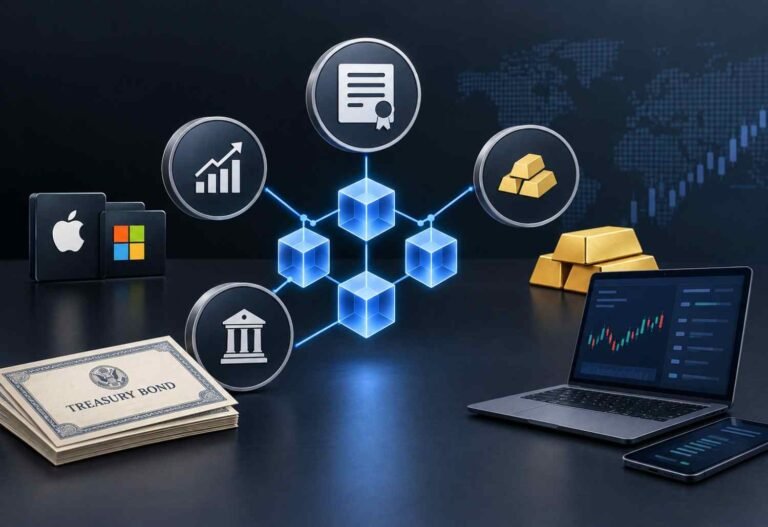
How blockchain and smart contracts manage tokenized securities, from issuance to settlement, with real 2026 figures and regulatory developments.
Issuing a token that represents a bond or a fund share is the easy part. The hard part starts the next morning: who owns what, who gets paid on Friday, how a trade settles, and what happens when something goes wrong. That day-to-day work is what people mean by onchain management of tokenized securities.
The idea is simple to state. Instead of passing records back and forth between brokers, clearing houses, custodians and depositories, some of those tasks run on a shared blockchain ledger, with smart contracts enforcing the rules. It is also easy to oversell. A blockchain record does not create a legal right on its own, and a fast transfer is not the same thing as legal finality.
Still, in 2026 this has moved well beyond white papers. Broadridge’s blockchain repo platform processed $8 trillion in July alone, the SEC has allowed DTCC to pilot tokenized entitlements, and the Bank of England has approved the first live platform in its Digital Securities Sandbox. This guide explains how onchain management works, what it can and cannot do, and what the evidence shows so far.
Key Takeaways
- Onchain management means using blockchain ledgers and smart contracts to handle ownership records, transfers, settlement, payments and servicing for tokenized securities.
- Real volume exists. Broadridge reported that its Distributed Ledger Repo platform settled $8.0 trillion in July 2026, an average of $365 billion a day.
- Regulators are building pathways, not removing rules. The US, EU and UK are each running controlled pilots with limits, reporting duties and safeguards.
- The likely outcome is hybrid. The IMF expects smart contracts to take over more operational work while regulated institutions keep governance, compliance and risk management.
- The weak spots are legal certainty, data quality and code risk, not the speed of the ledger.
What Is Onchain Management of Tokenized Securities?
A security is a financial instrument that gives its holder defined rights, such as a share, a bond or a fund unit. Tokenization represents those rights, or a legal claim connected to them, as a token on a blockchain. The Bank for International Settlements (BIS) frames tokenisation more broadly as moving claims on money and assets onto programmable platforms, and in its Annual Economic Report 2025 it argues the full benefits arrive when central bank money, commercial bank money and government bonds sit together on a “unified ledger.”
Read more: Tokenized Assets in 2026: Who Is Launching What, and Why It Matters – Ledger Tribune
Onchain management is what happens after the token exists. It covers ownership records, transfers, eligibility checks, settlement, interest and dividend payments, voting and, eventually, redemption.
In the traditional chain, a broker records the trade, a clearing house works out who owes what, a depository updates the register, and a custodian handles income and reporting. Each party keeps its own books, so a surprising amount of effort goes into making those books agree. A shared ledger can collapse some of those steps, because participants work from the same record and can program certain rules directly into it.
Not every tokenized security works the same way. Some are native: the security is issued on a blockchain, and the onchain record is the primary register. Others are mirrors or wrappers: the token represents an entitlement to a security that is still held at a traditional depository. The DTCC pilot described below is the second type.
That distinction decides what an investor legally owns. Before assuming a token is the security, read the offering terms and find out who stands behind the underlying asset.
How the Onchain Securities Lifecycle Works
A tokenized security passes through five broad stages, and blockchain tools can help at each one.
1. Issuance
The issuer sets the terms: how much is being raised, what rights investors receive, how payments work and which restrictions apply. A smart contract can then define how many tokens exist, which wallet addresses may hold them and what conditions apply to transfers.
The key control here is supply. The number of tokens must match the authorized issuance, and no one should be able to mint extra tokens or quietly change the terms. That is why institutions put so much weight on access controls and audits at this stage.
2. Ownership Records and Custody
Once issued, tokens need a reliable record of who holds them. A blockchain can show balances and transaction history to authorized participants. But the onchain balance and legal ownership are not always identical. Depending on the structure, a holder may own the security directly or may hold a claim through an intermediary.
Custody matters just as much. Some investors control their own wallets, while others rely on a regulated custodian. Each model comes with different security duties, and each needs a plan for lost keys, compromised accounts and disputed ownership.
3. Trading and Transfer
Tokens can move between eligible investors through approved platforms. Smart contracts can check each transfer against rules before it goes through. A tokenized fund, for example, can refuse to send tokens to any wallet that has not passed identity checks or does not sit in a permitted jurisdiction.
The caveat is that a token transfer is not automatically a lawful securities trade. Venue rules, broker obligations and investor protections can still apply.
4. Settlement and Payment
Settlement is where a trade is completed: the buyer receives the asset and the seller receives the money. Blockchain systems can support delivery-versus-payment (DvP), where the security moves only if the payment moves too. When both legs run on compatible systems, a smart contract can execute them together, which removes the risk of one side delivering and never being paid.
Speed, though, depends on the design. The IMF notes that DvP is already embedded in the international standards for financial market infrastructure, so tokenization is not inventing the concept; it is changing how it can be delivered. And a token that moves in seconds has not necessarily reached legal settlement finality.
5. Servicing and Redemption
Securities need care after purchase. Bonds pay coupons, funds distribute income, shareholders vote, and at maturity the issuer repays. Smart contracts can automate parts of this when they have accurate data on who holds what and a payment mechanism to draw on.
The details need real thought: who qualifies for a payment, on what date eligibility is measured, and what happens if the issuer misses an obligation. Code can execute those rules, but people still have to write them well.
What Smart Contracts Actually Do (and What They Can’t)
Smart contracts are programs that run on a blockchain and carry out predefined instructions when conditions are met. In securities markets they typically handle transfer restrictions, payment calculations, collateral movements and parts of the settlement process.
Their strength is consistency. A well-written contract applies the same rule to every transfer, every time, without someone checking a spreadsheet.
Their limits are just as real. A smart contract cannot verify facts from the outside world by itself. For things like interest rates, valuations or payment confirmations it needs outside data feeds, often called oracles, and bad data produces bad actions. A coding error will also be executed faithfully. The IMF’s April 2026 note on tokenized finance lists the governance of smart contracts among the areas where regulators should focus, alongside settlement finality, interoperability and access to safe settlement assets.
The practical lesson is to treat smart contracts as tools for automating clearly defined tasks. They sit on top of legal agreements and sound operations; they do not replace them.
Where It Is Already Happening: The 2026 Numbers
Talk of tokenization can drift into hype, so it helps to look at what is actually running.
Tokenized Repo: Broadridge DLR
The clearest volume figure comes from the repo market. Repo is short-term secured lending, usually against high-quality collateral, and it is a natural starting point because trades are standardized and repeated constantly. According to Broadridge, its Distributed Ledger Repo (DLR) platform processed $8.0 trillion in July 2026, at an average of $365 billion per day, up 28% from a year earlier.
The pattern in the company’s monthly releases is worth noticing. Daily averages were reported at $362 billion in February and $357 billion in June, so volume has hovered around the same level through the year. The year-over-year growth rate has dropped from 457% in February to 28% in July mainly because the comparison base got so much larger. In other words, the platform moved from rapid ramp-up to steady, large-scale use.
One caution: these are transaction volumes reported by the operator. Repo collateral rolls over constantly, so they do not equal the value of assets sitting on a blockchain at any moment.
United States: The DTCC Pilot
On 11 December 2025, SEC staff issued a no-action letter allowing the Depository Trust Company (DTC), DTCC’s subsidiary, to run a limited three-year pilot in which participants can choose to hold “tokenized entitlements” recorded on a distributed ledger. Eligible assets include Russell 1000 stocks, US Treasuries and major index-tracking ETFs.
The design shows how cautious the hybrid approach is:
- Registered ownership of the underlying securities stays in the name of DTC’s nominee, Cede & Co.
- Tokens move only between wallets registered with DTCC.
- DTCC keeps the ability to reverse or correct transactions in cases of error or misconduct.
- DTCC must report to SEC staff quarterly on participation, tokenized values, outages and other metrics.
A few days later, DTCC announced a partnership with Digital Asset to tokenize a subset of DTC-custodied US Treasuries on the Canton Network. A staff no-action letter is not a change in law, so it is best read as permission to test under supervision. Check DTCC’s own announcements for the current status of the rollout.
European Union: The DLT Pilot Regime
The EU’s Regulation (EU) 2022/858 has applied since 23 March 2023 and lets approved operators run trading and settlement venues on distributed ledgers with some exemptions from existing rules. It also sets tight limits. Eligible instruments include shares of issuers with a market capitalisation below €500 million, bonds with an issue size below €1 billion and fund units where assets under management are below €500 million. The total market value of instruments on any one infrastructure must stay under €6 billion, and at €9 billion the operator has to activate a transition strategy, as the French regulator’s pilot regime overview explains.
Those caps have drawn criticism for being too small to support real scale. ESMA’s own review recommended recalibrating the thresholds, and the Commission has since proposed amendments.
United Kingdom: The Digital Securities Sandbox
The Bank of England and the FCA jointly run the Digital Securities Sandbox (DSS), launched in 2024. In July 2026, HSBC announced that its Orion platform became the first approved to go live in the sandbox, operating as a digital securities depository for digitally native bonds. That platform is expected to host the first transaction of the UK government’s Digital Gilt Instrument (DIGIT) in the first quarter of 2027.
What the BIS and IMF Say
Two international institutions have shaped much of the policy debate.
The BIS’s 2025 report argues that tokenisation can improve existing processes and enable new arrangements, and that a unified ledger combining tokenised central bank reserves, commercial bank money and government bonds is the best way to capture those gains. It also concludes that stablecoins fall short of the tests of singleness, elasticity and integrity needed to anchor the monetary system. Its press release summarizes the case.
The IMF’s July 2026 working paper, Financial Market Infrastructures Evolution in a Tokenized Economy (WP/26/136), is a 52-page study by Yaiza Cabedo, Tommaso Mancini-Griffoli, Fabian Schär and Nicolas Zhang. It argues that smart contracts and distributed ledgers can perform a substantial share of the functions carried out by central securities depositories, settlement systems, central counterparties and trade repositories. Its central conclusion is that tokenization means institutional redesign rather than disintermediation.
Key Benefits of Onchain Management
Faster settlement. When assets and payments live on compatible rails, steps that once took a day or more can compress into a single coordinated process. That shortens the window in which a counterparty can fail to deliver.
Less reconciliation. Firms spend considerable time comparing their records with everyone else’s. A synchronized ledger can cut the number of mismatches, although internal accounting and risk systems will still need to connect to it.
Better collateral mobility. The repo figures above show the clearest use case: tokenized collateral that moves between counterparties in real time can help firms manage liquidity more precisely. The IMF’s tokenized finance note also points to atomic settlement, continuous liquidity management and embedded compliance as the main gains.
Greater transparency and auditability. Authorized participants can trace transfers and balances more easily. The trade-off is privacy, which is why many institutional systems use permissioned networks.
Possible access gains. Smaller units and new distribution channels may widen participation, but minimum investment rules, eligibility checks and local securities laws still apply.
Risks and Compliance Challenges
Legal enforceability. The biggest open question is what rights a token holder actually has, particularly if an issuer, custodian or platform fails. A blockchain entry cannot replace a contract or securities law.
Identity and transfer controls. Know-your-customer and anti-money-laundering duties still apply. Controls built into the token can help, but they must work as intended and be designed in from the start, not added after tokens are distributed.
Cybersecurity and code errors. Compromised keys, software bugs and operational outages are all possible. Independent audits, access controls, monitoring and incident-response plans are baseline requirements.
Concentration and speed. The IMF’s tokenized finance note warns that without strong policy anchors, tokenization could amplify instability through speed, concentration and fragmentation. If critical smart contracts become too important to fail, they may deserve oversight comparable to systemically important institutions.
Liquidity. A token is easy to move, but that does not guarantee someone will buy it at a fair price. Liquidity can disappear in stressed markets even when the blockchain keeps running perfectly.
Privacy. Putting personal or commercially sensitive data on a public chain can create long-lasting exposure. Most designs keep sensitive documents off-chain and record only what is needed to verify transactions.
The Role of Banks, Custodians and Market Infrastructure
Onchain management does not make traditional institutions disappear. It changes what they do.
Banks still provide payments, financing and custody. Custodians still safeguard assets and support clients. Depositories and clearing houses still carry legal and supervisory responsibility. The IMF paper’s most useful idea is a hybrid model: smart contracts handle more operational and transactional functions, while legal entities remain responsible for governance, compliance, risk management and intervention to keep the market running in a crisis.
The paper says hybrid arrangements are especially likely where processes depend on off-chain information, require coordination across several ledgers, or rely on legal recognition that blockchain settlement does not yet have everywhere.
This fits what the pilots show. The DTCC pilot keeps registered ownership with Cede & Co., the EU regime caps volumes and keeps regulators involved, and the UK sandbox works under Bank of England and FCA supervision. Interoperability will be the next test, because institutions will need to move assets and information across different blockchains and legacy systems without losing records or weakening controls.
What Institutions Should Do Before Adopting
- Name the problem. Faster settlement, lower reconciliation costs, collateral mobility and automated payments call for different designs.
- Settle the legal structure first. Define investor rights, what the token represents, transfer rules, redemption terms and what happens if a provider fails.
- Choose technology that fits the rules. Compare capacity, cost, privacy, governance and integration with existing systems.
- Pilot before scaling. Test in a limited setting to find technical weaknesses, delays and hidden costs, and check whether results beat current processes.
- Assign ownership of operations. Someone must monitor contracts, manage updates, respond to incidents and keep regulatory reporting accurate.
In short, treat adoption as a change to how financial obligations are managed, not as a software upgrade.
Frequently Asked Questions
What is onchain management of tokenized securities?
It is the use of blockchain ledgers and smart contracts to record ownership, process transfers, settle trades, make payments and manage other lifecycle events for securities represented as digital tokens.
Is a tokenized security the same as a cryptocurrency?
No. A tokenized security represents rights in a regulated financial instrument, such as a bond or fund unit, and is generally subject to securities law. Most cryptocurrencies do not represent such rights.
How is onchain settlement different from traditional settlement?
Traditional settlement moves information between several separate systems. Onchain settlement can update ownership and payment on a shared ledger at the same time, which supports delivery-versus-payment. Legal finality still depends on the applicable law and the platform’s rules.
Are tokenized securities legal?
It depends on the jurisdiction and structure. The US, EU and UK each allow tokenized securities within defined pilots or frameworks, with limits and supervision. Always check the relevant regulator’s current guidance.
Do banks and custodians still matter?
Yes. Research from the IMF concludes that regulated institutions will keep responsibility for governance, compliance and risk management even as smart contracts automate more operational work.
Conclusion: Managing Securities Beyond Tokenization
The real value of tokenization lies in what happens after the token is created. Shared records, programmable transfer rules, coordinated settlement and automated servicing can make parts of the securities lifecycle faster and tidier, and the 2026 evidence, from Broadridge’s repo volumes to the DTCC, EU and UK pilots, shows institutions are already putting this to work.
But the benefits are not automatic. Legal rights must be clear, data must be reliable, code must be audited, and someone must remain accountable when systems fail. The most credible path forward combines blockchain efficiency with the legal and operational strengths of established institutions. Technology may change how securities are managed, but trust will still rest on the rules and organizations behind each transaction.

Bilal Hassan is a seasoned crypto journalist with over five years of experience covering blockchain, digital assets, and global fintech trends. His work focuses on market developments, regulatory shifts, and the evolving landscape of cryptocurrency adoption worldwide.
