
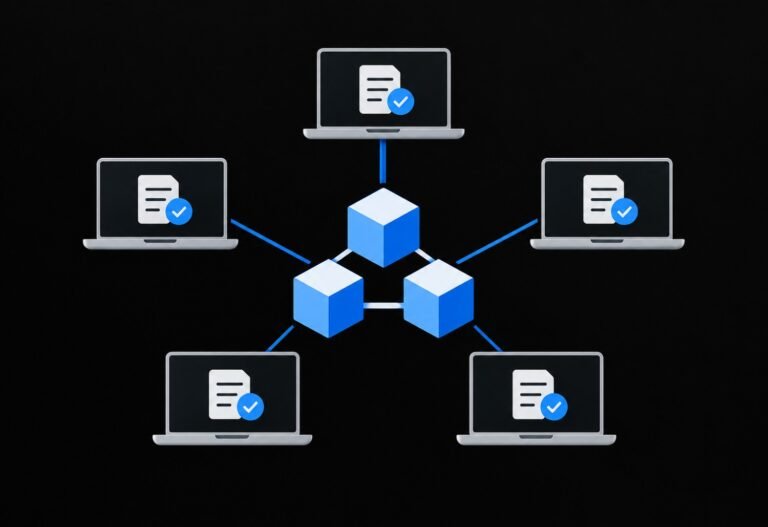
Learn what decentralized ledger technology is, how it works, how it differs from blockchain, and where it is used today. Clear examples included.
What Is Decentralized Ledger Technology?
Decentralized ledger technology is a way to record data without a central owner. Many computers share and update the same record. No single company or person controls it.
People often shorten it to DLT. You may also see the term distributed ledger technology. Both phrases describe the same core idea. The record lives in many places at once.
Think about a normal bank. The bank keeps your account record on its own servers. You trust the bank to keep that record safe and correct. If the bank makes a mistake, you must rely on the bank to fix it.
DLT changes that setup. Instead of one keeper, a network of participants holds copies of the record. They follow shared rules to agree on every update. This makes the record harder to change in secret.
This guide explains the topic in plain language. You will learn how DLT works, which types exist, and where people use it today. You will also see the risks, so you get a balanced view.
How Is a Normal Ledger Different From a Decentralized Ledger?
A ledger is simply a record of transactions. Merchants used paper ledgers for centuries. Later, banks and companies moved those records into databases. Each of these ledgers had one owner.
A centralized ledger has a clear weak point. If the owner fails, the record fails. If an insider edits the data, others may never notice. Users must simply trust the owner.
A decentralized ledger spreads the work. Every participant, called a node, can store a copy. When new data arrives, the nodes check it against the rules. The network accepts the data only when enough nodes agree.
Here are the main differences:
- Control: A central ledger has one owner. A decentralized ledger has many.
- Trust: A central ledger asks you to trust the owner. A decentralized ledger asks you to trust the rules and the math.
- Failure risk: A central ledger can fail at one point. A decentralized ledger keeps running if some nodes go offline.
- Transparency: A central ledger is private by default. Many decentralized ledgers let anyone inspect the record.
None of this makes DLT better in every case. Central systems are often faster and cheaper. The right choice depends on the job.
How Does a Decentralized Ledger Work?
A decentralized ledger follows a simple flow. Each step builds on the one before it. Let us walk through it.
Step 1: A user starts a transaction. For example, Adam wants to send a digital asset to Bob. She signs the request with a private key. The signature proves the request came from her.
Step 2: The network receives the request. Alice’s transaction spreads across the nodes. Each node gets a copy of the pending request. Nodes then check that the signature is valid and that Adam has enough funds.
Step 3: Nodes group valid transactions. The network collects many valid requests together. In a blockchain, these groups are called blocks. Other ledger designs may group data in different ways.
Step 4: The network reaches agreement. This is the key step. The nodes use a consensus mechanism to agree on which update is official. We explain these mechanisms in the next section.
Step 5: The record updates everywhere. Once the network agrees, each node adds the new data to its copy. Now everyone holds the same updated record.
Step 6: The data becomes hard to change. New entries link to older ones using cryptography. A hash is a digital fingerprint of data. If someone alters old data, its fingerprint changes. The mismatch is easy for the network to spot.
This design gives DLT its best-known traits. The record is shared, time-stamped, and tamper-resistant. Still, “tamper-resistant” does not mean “impossible to attack”. We cover those limits later.
What Are Consensus Mechanisms in DLT?
A consensus mechanism is a set of rules for agreement. It answers one question. How do strangers agree on the truth without a boss?
Different networks answer this in different ways. Here are the most common ones.
Proof of Work
Proof of work asks participants to solve a hard math puzzle. The first to solve it earns the right to add the next block. Bitcoin uses this method.
The puzzle takes real computing power. That cost makes cheating expensive. An attacker would need huge resources to rewrite the record.
However, proof of work uses a lot of electricity. Critics point to this cost often. Supporters argue that the energy buys strong security.
Proof of Stake
Proof of stake picks validators based on the coins they lock up. Validators put their own funds at risk. If they cheat, they can lose part of that stake.
Ethereum moved from proof of work to proof of stake in September 2022. That upgrade was called the Merge. According to the Ethereum Foundation, it cut the network’s energy use by more than 99 percent.
Proof of stake is cheaper to run. Some critics worry it may favor wealthy holders. Developers keep working on designs to reduce that risk.
Delegated and Federated Models
Some networks let token holders vote for a small group of validators. This is called delegated proof of stake. It can process transactions faster. The trade-off is that fewer parties hold power.
The XRP Ledger uses a different approach. Trusted validators on each node’s list reach agreement through repeated voting rounds. It needs no mining at all. This helps it settle payments in seconds.
Byzantine Fault Tolerance
Byzantine fault tolerance, or BFT, is a family of methods. They let a network reach agreement even when some nodes lie or fail. Many private and enterprise ledgers use BFT-style voting.
The name comes from a famous computer science puzzle. In it, generals must agree on a plan while some may be traitors. The idea fits DLT well.
No method is perfect. Each one trades speed, cost, security, and decentralization against each other. Builders choose the mix that fits their goal.
Is Decentralized Ledger Technology the Same as Blockchain?
No, they are not the same. Blockchain is one kind of DLT. Think of DLT as the big category. Blockchain is one type inside it.
A blockchain stores data in blocks. Each block links to the one before it. Together they form a chain. Bitcoin and Ethereum both use this structure.
Other ledgers skip the chain of blocks. Some use a directed acyclic graph, or DAG. In a DAG, transactions link to earlier transactions directly. There is no single line of blocks. IOTA is one project that uses a DAG called the Tangle.
Hedera uses another design called hashgraph. It spreads information through a method often described as gossip. Nodes share what they know with random peers. The network then votes on the order of events.
So here is the simple rule:
- Every blockchain is a distributed ledger.
- Not every distributed ledger is a blockchain.
This point matters for search and for clear writing. Many articles use the words as if they mean the same thing. They do not. Using them correctly helps your readers and builds trust.
What Are the Main Types of Distributed Ledger Technology?
DLT networks differ in who can join and who can read the data. Most fall into three groups.
Public Ledgers
Anyone can join a public ledger and anyone can read the data. Anyone can often help validate new entries. Bitcoin and Ethereum are public networks.
Public ledgers offer strong openness. They also face hard trade-offs. They can be slower, and every detail is visible to the world.
Private Ledgers
A private ledger limits who can join. One organization usually runs it. Only approved parties can read or write data.
Companies like private ledgers for internal records. They get better privacy and speed. The cost is less decentralization. In some cases, a private ledger is not much different from a normal database.
Consortium Ledgers
A consortium ledger sits between the first two. A group of organizations shares control. For example, several banks might run one network together.
This model fits industries where rivals must still cooperate. Each member holds a share of the power. No single member can rewrite the record alone.
Permissioned and Permissionless
You will also see these terms. A permissionless network lets anyone take part. A permissioned network requires approval first. Public ledgers are usually permissionless. Private and consortium ledgers are usually permissioned.
What Are the Benefits of Decentralized Ledger Technology?
DLT has real strengths. These are the benefits most often cited.
Transparency. On many networks, participants can inspect the same record. This helps audits and builds shared confidence.
Security. Cryptography protects the data. An attacker must change many copies at once. That is far harder than breaching one server.
Resilience. The network does not rely on one machine. If some nodes fail, others keep going. This lowers the risk of a single point of failure.
Traceability. Every entry carries a timestamp and a link to earlier entries. You can follow an asset’s history from start to finish.
Fewer intermediaries. DLT can let two parties transact directly. This may cut fees and delays in some processes. International payments are one example.
Automation. Some ledgers support smart contracts. A smart contract is code that runs when set conditions are met. It can release a payment once goods arrive, with no manual step.
These gains are real. Yet they depend on good design. A poorly built ledger can lose most of these advantages.
What Are the Risks and Limits of DLT?
A fair guide must also cover the downsides. Here are the main ones.
Scalability. Many networks process fewer transactions per second than card networks. Agreement among many nodes takes time. Developers keep building faster layers on top to ease this.
Energy use. Proof of work networks use large amounts of power. Newer methods like proof of stake use far less. Still, the debate continues.
Privacy trade-offs. Public ledgers show transaction data to everyone. Addresses are not names, but patterns can reveal identities. Privacy tools exist, yet they add complexity.
The 51 percent attack. If one party gains most of a network’s power, it may rewrite recent history. This is very costly on large networks. Smaller networks face a higher risk.
Smart contract bugs. Code mistakes can lock or drain funds. On many ledgers, you cannot easily undo a transaction. This makes careful audits vital.
Regulation. Rules differ by country and change often. Companies that use DLT must watch legal updates closely. Readers should do the same before they act.
Immutability cuts both ways. A record that is hard to change protects against fraud. It also makes honest errors hard to fix. Wrong entries can stay forever.
Because of these limits, DLT is not a cure for every problem. Smart teams ask a simple question first. Do we truly need many parties to share a record without a central owner? If not, a normal database may work better.
What Are Real-World Examples of Decentralized Ledgers?
Several well-known networks show how DLT works in practice. Each takes a different path.
Bitcoin
Bitcoin was the first major use of the idea. An anonymous person or group using the name Satoshi Nakamoto published the white paper in 2008. The network went live in January 2009.
Bitcoin is a public, permissionless blockchain. It uses proof of work. Its main job is to record transfers of its own digital currency.
Ethereum
Ethereum launched in 2015. It added smart contracts to the mix. This let developers build apps that run on the network itself.
Today, Ethereum supports decentralized finance, digital collectibles, and many other apps. It is a public blockchain that uses proof of stake.
XRP Ledger
The XRP Ledger went live in 2012. It does not use mining. Instead, it relies on a consensus protocol among trusted validators. It focuses on fast and low-cost payments.
Hyperledger Fabric
Hyperledger Fabric is an open-source framework for enterprise use. It began under the Linux Foundation. Companies use it to build permissioned networks. Members can control who sees which data.
R3 Corda
Corda is built mainly for financial firms. Unlike many blockchains, it shares data only with parties involved in a deal. This suits regulated settings where privacy matters.
Hedera
Hedera uses hashgraph instead of a blockchain. A council of large organizations governs it. It aims for high speed and low fees.
These examples show a wide range. Some stress openness. Others stress privacy or speed. All share the core DLT idea of a ledger kept by many parties.
How Do Industries Use Decentralized Ledger Technology?
DLT reaches far beyond digital coins. Here are some leading areas.
Finance and Payments
Banks and payment firms test DLT for faster settlement. Today, some cross-border payments take days. A shared ledger can cut the number of steps. Fewer steps can mean less delay.
Tokenization is another trend. It turns rights to real assets into digital tokens. Examples include bonds, funds, and property shares. Large financial firms have run pilots in this area.
Supply Chain
A product often passes through many hands. Farmers, shippers, and stores each keep their own records. Mismatches cause delays and disputes.
A shared ledger gives all parties one view. A buyer can trace a product back to its source. Food safety teams use this to find the origin of a problem faster.
Healthcare
Health data sits in many separate systems. DLT could help share certain records with patient consent. It could also track the path of medicines. This may help fight counterfeit drugs.
Privacy rules are strict in this field. Most designs keep sensitive data off the ledger. They store only proof or references on it.
Digital Identity
People prove who they are in many places. Each service often asks for the same documents. A decentralized identity system lets users hold their own credentials. They can share only the facts needed.
Voting and Public Records
Some governments and groups explore DLT for land records. A shared record can reduce disputes over ownership. Voting pilots exist too. Experts urge caution here, since security and trust stakes are very high.
Many of these projects remain in early stages. Some will succeed. Others will fade. Readers should look for working products, not just announcements.
What Is the Future of Decentralized Ledger Technology?
The future looks active but uncertain. Several trends stand out.
First, networks keep getting faster. Layer two systems process transactions off the main chain. They then post proof back to it. This approach eases congestion.
Second, interest from large institutions is growing. Banks, asset managers, and payment firms continue to test tokenized assets. Clear regulation will shape how far this goes.
Third, interoperability is a major goal. Today, many ledgers cannot talk to each other. Builders are creating bridges and shared standards. Better links would make DLT more useful.
Finally, privacy tools are improving. Methods like zero-knowledge proofs let a user prove a fact without revealing the data. This could help DLT fit privacy-sensitive fields.
No one can predict the exact path. Still, the core idea of a shared, hard-to-alter record seems likely to stay relevant.
Frequently Asked Questions About Decentralized Ledger Technology
What does DLT stand for?
DLT stands for decentralized ledger technology. Many people also use it for distributed ledger technology. Both terms describe a record that many computers share and update together.
Is a decentralized ledger safe?
It can be very secure. Cryptography and shared copies make tampering hard. Still, safety depends on design. Weak code, small networks, and user mistakes can create risks.
Can a decentralized ledger be hacked?
The core ledger of a large network is very hard to alter. Most real losses come from side issues. Examples include stolen private keys, flawed smart contracts, and weak exchanges.
Who controls a decentralized ledger?
No single party does on a truly decentralized network. Rules are set in the software. Participants follow them. Changes usually need broad agreement from the community or members.
Is Bitcoin a decentralized ledger?
Yes. Bitcoin is a public blockchain, and a blockchain is a type of decentralized ledger. Thousands of nodes keep copies of its record.
What is the difference between a database and a decentralized ledger?
A normal database has one owner who can edit entries. A decentralized ledger has many holders who must agree on changes. This makes silent edits much harder. A database is usually faster and simpler.
Do I need cryptocurrency to use DLT?
Not always. Public networks often use a native token to pay fees. Many private ledgers need no token at all. Companies use them to share records without any coin.
Final Thoughts: Why Does Decentralized Ledger Technology Matter?
Decentralized ledger technology changes who holds the record. Instead of one trusted keeper, many parties share the job. Rules and cryptography replace blind trust.
The benefits are clear. You get transparency, resilience, and traceability. The limits are clear too. Speed, privacy, and regulation remain open challenges.
If you remember one thing, remember this. Blockchain is one kind of DLT, not the whole field. Knowing that difference helps you read news and project claims with more care.
As always, do your own research before you act on any crypto project. This article is for education only. It is not financial advice.

Bilal Hassan is a seasoned crypto journalist with over five years of experience covering blockchain, digital assets, and global fintech trends. His work focuses on market developments, regulatory shifts, and the evolving landscape of cryptocurrency adoption worldwide.
