
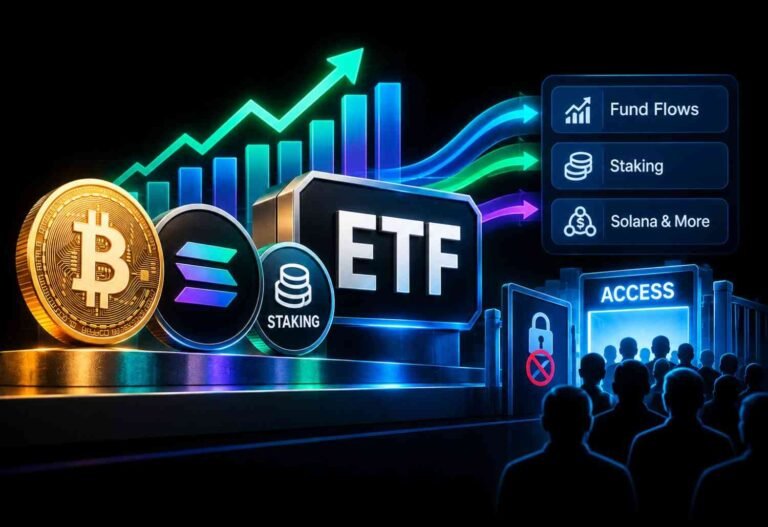
A crypto ETF lets you invest through a brokerage account. Learn how Solana ETFs, staking, fund flows and brokerage access work in 2026.
For years, “crypto ETF” meant two tickers and one question: would the SEC ever let Bitcoin into a regular brokerage account? That question has an answer now. The fight today is over everything else. Solana funds that stake your coins. Hyperliquid and Dogecoin wrappers. Morgan Stanley undercutting rivals on fees. Vanguard opening its doors after years of saying no. Call it ETF hopium or call it “tradfi is here.” Either way, the shelf looks nothing like it did in 2024.
A crypto ETF is a fund you buy through a normal brokerage account that tracks one or more crypto assets, so you never have to buy, store, or secure the coins yourself. A spot crypto ETF holds the actual coin, so its share price follows the coin’s market price, minus fees.
This guide covers what’s moving right now, what you’re really buying when you click “buy,” why Solana became the altcoin test case, how staking changes fund design, and how to read inflows without falling for “when ETF then moon” thinking. It also explains why brokerage shelves matter as much as SEC approvals. Bitcoin, Ethereum, and XRP get their own hubs, linked below, so this page can stay wide.
The Crypto ETF Desk: What’s Moving Right Now
This is the fastest-changing part of the page. The three threads stay the same. The examples inside them get swapped as the market moves.
The Solana and Altcoin Filing Race
The big shift in 2026 is that the altcoin race moved from filings to real listings, and from plain exposure to yield. On July 28, 2026, Morgan Stanley launched Ethereum and Solana ETPs on NYSE Arca. The sponsor fee is 0.14%, below Franklin Templeton’s Solana fund at 0.19%. The Solana product, MSOL, can stake up to all of its SOL. Figment was named a staking provider, with about 95% of staking rewards expected to pass through to shareholders. The prospectus also lists Galaxy and Coinbase Canada as delegated providers.
The rest of the shelf has filled in too. Canary’s Litecoin and Hedera funds were already collecting flows by November 2025. Later that month, Grayscale debuted the first spot Dogecoin ETF, GDOG, on NYSE. By early October 2026, Grayscale’s Hyperliquid Staking ETF (HYPG) held about $478 million in net assets. Even Sui got a path: Grayscale moved toward a NYSE Arca debut for its Sui ETF in February.
Notice the pattern. Issuers no longer compete only on access. They compete on fees and yield. The staking-provider appointments matter for reasons we’ll get to below.
Flow Prints and AUM Milestones
Flow data is where the hopium meets reality. In the week of September 28 to October 2, 2026, U.S. spot Solana ETFs took in about $2.4 million net. Cumulative net inflows sat at $1.61 billion, and total net assets were near $1.9 billion, roughly 2.75% of SOL’s market cap. That same week, Bitcoin funds drew about $241 million while Ether funds lost about $138 million.
Solana’s year has had both extremes. In late August, the funds posted their best single day of 2026, around $61 million, as Bitcoin and Ether funds extended inflow streaks. By October 13, Solana funds saw a small $1.04 million outflow on a day Bitcoin funds added more than $175 million.
Treat these numbers as a read on access demand, not a price promise. A fund can take in money while the coin falls.
Shelf Decisions and Pipeline Tempo
The quiet driver behind many of those flows is distribution. When Vanguard let its 50 million brokerage clients trade third-party crypto ETFs from December 2, 2025, it didn’t launch a product of its own. It just removed a wall. And when Morgan Stanley entered, Bloomberg’s Eric Balchunas noted that its advisor network can reach clients who may never see a smaller issuer’s fund. How fast the SEC and exchanges can process new products is covered in the gatekeepers section below.
Crypto ETF Basics: What You’re Actually Buying
A crypto ETF is a wrapper. The fund holds the asset, or a contract tied to it, through a custodian. You buy shares of the fund and you don’t hold keys, set up a wallet, or sign into an exchange. You also don’t own the coin itself, so you can’t send it, use it in DeFi, or vote with it.
There are two main families. Futures-based products hold derivative contracts instead of the asset. They were the first route into brokerage accounts. Spot crypto ETFs hold the asset, which is why they track price more closely and why they became the category’s landmark. Futures funds can drift from the spot price because of how contracts roll over. Spot funds mostly follow the coin, minus fees.
Why does “crypto ETF” now include altcoins? Because the rules changed. In September 2025, the SEC approved generic listing standards for commodity-based trust shares. Exchanges could now list qualifying products without a separate rule filing for each one. A two-asset club became an open shelf with rules.
ETF vs ETP: Same Job, Different Plumbing
You’ll see both labels in crypto ETF news, and they aren’t the same thing. In the U.S., many spot crypto products are exchange-traded products set up as trusts, not traditional funds registered under the Investment Company Act of 1940. As one law firm explains, most U.S. spot crypto vehicles trade as commodity-based trust shares and have to meet exchange listing criteria. In Europe, exchange-traded notes and other ETP structures do a similar job under different rules. Both give you exchange-traded access. The legal plumbing differs, so check what you actually hold.
Four Headlines, Four Meanings
Crypto ETF news mixes four very different events. Mixing them up is how bad takes spread.
- Filing: An issuer files paperwork, usually an S-1. It shows intent, not availability.
- Approval or effectiveness: A regulator clears the rule change, or the registration becomes effective. Under generic listing standards, this can be automatic for qualifying products.
- Listing: Shares start trading. This is the first moment a retail investor can buy.
- Flow-day headline: Money moved in or out. It describes demand, not safety or price direction.
Two more storylines need their own tracking. Staking amendments are an issuer changing its filing to add yield. That’s a product change, not an approval milestone. Issuer competition is several firms racing to list similar funds, and it usually shows up first in fees. Also watch for price-prediction articles that borrow ETF keywords. They’re chart commentary, not product education.
The Solana ETF: Why It Became the Altcoin Test Case
The Solana ETF is the defining altcoin story because it answered a question the market had asked since Bitcoin: would anything beyond the first two assets attract real money? Bitwise’s BSOL debuted on October 28, 2025. It pulled in roughly $420 million in its first short trading week, counting seed capital, according to Bloomberg analyst Eric Balchunas as quoted by The Block. Within weeks, the funds logged 20 straight days of net inflows.
That run beat what many people expected for an asset with perceived regulatory and technical risk. It also set a template. Other proof-of-stake assets now look to Solana as the path a fund outside Bitcoin and Ether can take.
What a Staking Provider Does Inside a Fund
Staking is how proof-of-stake networks stay secure. Holders lock up tokens with validators and earn rewards. A plain spot fund just holds the coin and passes none of that yield along. A staking ETF changes that.
Inside a fund, the staking provider runs or coordinates the validators that stake the trust’s tokens. It handles technical risks like downtime and slashing, and it reports rewards back to the fund. Figment calls itself the largest non-custodial staking provider for Ethereum and Solana, which helps explain why issuers hire specialists instead of building validator operations in-house. Morgan Stanley’s setup, with up to 100% of SOL potentially staked and 95% of rewards expected to flow to shareholders, shows how much of the fund’s economics now sits in the staking layer.
Why the rush? Once plain exposure becomes a commodity, yield becomes the edge. A staking fund offers something you’d normally get on an exchange, but inside a brokerage account. Ethereum shows how recent this is. When spot ETH funds launched in July 2024, staking was off the table. A major bank-affiliated issuer shipped an Ether fund with staking from day one only in 2026. Staking also adds new things to watch: network-specific risks and the timing of reward payouts.
The thesis to carry forward is simple. Proof-of-stake ETF races increasingly build staking into their filings and appoint specialist providers for institutional wrappers.
The Issuer Race and the Flow Data
BSOL still leads. It holds roughly 80% of cumulative inflows across U.S. spot Solana ETFs, with Grayscale’s GSOL and Fidelity’s FSOL behind it. Bigger names have since joined, which is why fee cuts and staking terms are now the main way funds try to stand apart.
For price analysis and network news, head to our Solana hub. This page is about the wrapper, not the chart.
Where the Single-Asset Deep Dives Live
| If you want depth on… | Go to |
| Bitcoin ETFs, issuers, and institutional flows | Bitcoin ETF and institutional hub |
| Ethereum ETFs and ether staking funds | Ethereum ETF and institutional hub |
| XRP ETFs and flows | XRP ETF hub |
| Solana price and network analysis | Solana hub |
Beyond Solana: How Wide the Shelf Is Getting
Once Solana worked, the shelf grew fast. The U.S. lineup now includes Litecoin, Hedera, Dogecoin, XRP, Hyperliquid, and more, and the pipeline keeps filling. Shortly before Vanguard’s decision, Bloomberg’s Eric Balchunas said more than 100 new crypto ETFs could launch within six months.
Tracking the Filing Pipeline
It helps to sort products into three tiers. Listed and trading covers Canary’s Litecoin and Hedera funds, Grayscale’s Dogecoin ETF, Hyperliquid products, and the Solana and XRP funds. Filed and waiting covers names like Cardano, Avalanche, and Polkadot. One batch filing of 21 products also included Hyperliquid, Sei, and Ethena, with several built to include staking rewards. Index wrappers bundle several assets into one fund, like the Grayscale Digital Large Cap fund approved on September 17, 2025.
Leveraged products add another layer. 21Shares launched a 2x leveraged Sui ETF on Nasdaq. That shows how quickly derivative-style wrappers can show up around a new name, and how different they are from a plain spot fund.
If you’re searching dogecoin etf news, hbar etf, or litecoin etf, start with one question: which tier is this product in? That filters out most of the noise.
Filing Headline vs Real Trading Availability
A filing is access news at best. It doesn’t guarantee trading, and it certainly doesn’t guarantee lasting assets. Plenty of filings sit for months, get amended again and again, or never list. Even listed funds can stay small. In one late-August 2026 week, Bitcoin and Ether funds took about 96.5% of all crypto ETF inflows, leaving everyone else to split a sliver. In July, Solana and Hyperliquid products made up nearly 80% of non-BTC, non-ETH ETF volume. A listing opens the door. Flows decide whether anyone walks through.
Reading Inflows and Outflows Without the Hopium
Every bull run brings its own inflow lore: the streaks, the record days, the “institutions are buying” posts. Used carefully, flow data is useful. Used carelessly, it turns into a price prediction in disguise.
What a flow print tells you. A net inflow means creations beat redemptions that day. Demand for regulated access went up. Cumulative figures show how much money has come through a product over its life. Assets as a share of a coin’s market cap show how much supply sits inside wrappers. For Solana, that share was around 2.75% in early October.
What it can’t tell you. It can’t tell you whether the price will rise. Some analysts argue steady inflows can tighten supply and support price, but an argument isn’t a floor. Funds also hold money from basis trades, rebalancing, and advisors shifting client portfolios. One day’s number rarely says which.
What to check. Look at weekly totals, not single days. Separate one fund’s flows from the category’s. Watch concentration: BSOL holds most of Solana ETF capital, so a category headline can really be one issuer’s story. Refresh the numbers often, because this is the shortest-lived section on the page. For daily figures, check Farside Investors and SoSoValue, the sources the outlets above cite.
The 2026 lesson is mixed on purpose. Bitcoin funds lost $681 million in the first full trading week of the year while XRP funds kept pulling in money. A few months later, Bitcoin ETF inflows hit $2.07 billion by August 20, already the biggest month of 2026. Flows rotate. They don’t move in a straight line.
The Gatekeepers: SEC Freezes and Brokerage Shelves
Two gates decide who can buy a crypto ETF: the regulator’s gate and the broker’s gate. Most coverage only talks about the first.
How One Processing Freeze Stalls Dozens of Applications
Before September 2025, each spot crypto ETP needed its own 19b-4 rule filing, and reviews could run up to 240 days. Generic listing standards cut that to as little as 75 days for qualifying products. Law firms covering the change noted that qualifying products no longer needed individual rule approval, though anything outside the standards still needed separate review.
Then the pace hit a wall. Congress missed its October 1, 2025 funding deadline, and the 43-day government shutdown froze discretionary reviews. More than 90 crypto ETF applications sat idle. The SEC said its filing system would keep accepting submissions even as reviews paused. Issuers found a workaround. By filing without a delaying amendment, some products became effective on their own after 20 days under Section 8(a). After the shutdown, SEC guidance pointed to a backlog of more than 900 registration statements and laid out a path to automatic effectiveness.
Two things stand out. Pipeline tempo is part of the category, because one freeze can stall dozens of products at once. And products that already trade keep running normally, since their daily mechanics depend on custodians and authorized participants, not constant SEC review.
Why Brokerage Shelf Decisions Matter as Much as SEC Approval
An approved fund only helps if you can buy it where your money sits. When a brokerage allows or blocks third-party crypto ETFs, it changes real-world distribution no matter what the regulator says.
Vanguard makes the point. For years it kept crypto products off its platform. As recently as August 2024, CEO Salim Ramji said Vanguard had no plans for crypto ETFs. Then it reversed, pointing to client demand and saying crypto ETFs had performed as designed through volatile periods. The policy covers third-party funds only, and reports say high-volatility products tied to speculative tokens stay out. So shelf access is a filter in its own right. Someone searching “vanguard crypto etf” or “vanguard bitcoin etf” is asking a distribution question, not a regulatory one.
The same logic explains why bank-affiliated issuers matter. Morgan Stanley’s Bitcoin trust grew to roughly $400 million in four months despite launching in a weak market. That shows what a built-in wealth network can do.
Adoption Rails
A third layer sits under both gates: the rails that move money. Crypto venues are adding stock and ETF trading. Industry outlooks now group ETFs with stablecoins and tokenization. Together, that suggests these products are merging into normal market plumbing. Those stories live elsewhere on our site. See our stablecoins hub for stablecoin depth and our crypto regulation hub for broader policy.
How We Got Here: A Short Timeline
This timeline is short on purpose. Check every date against primary sources before relying on it.
2021: Futures-Based ETFs Open the Door
The first U.S. crypto ETFs held Bitcoin futures, not Bitcoin. They gave brokerage investors exposure without custody. They also set up the argument that later undercut the case for rejecting spot products.
January 2024: Spot Bitcoin ETFs Approved
The SEC approved 11 spot Bitcoin applications on January 10, 2024, from issuers including BlackRock, Fidelity, Grayscale, and Bitwise. Trading began January 11. A court ruling helped. In 2023, the D.C. Circuit held that the SEC acted arbitrarily by rejecting a spot listing while approving similar futures products.
2024: Spot Ethereum ETFs Follow
Nine spot Ether ETFs began trading on July 23, 2024. They had no staking, because a workable plan was still months away at best.
2024-2025: The Altcoin Filing Wave
Issuers filed for Solana, Litecoin, Hedera, Dogecoin, and more. The wave turned into listings after generic listing standards arrived on September 17, 2025. Solana debuted on October 28, and Dogecoin followed in late November.
2025: Staking Enters ETF Design
Staking began showing up inside proof-of-stake filings, and Bitwise’s BSOL became the flagship staking-linked Solana product. In 2026, Morgan Stanley put staking in from day one in a product from a major bank-affiliated manager.
2025-2026: Freezes and Brokerage Debates
The shutdown froze reviews from October 1 to November 12, 2025. On December 2, Vanguard reversed course. As of this update, we couldn’t verify a comparable freeze in 2026. Treat any claim of a new one with caution until you see the SEC’s own notice.
FAQ
What is a crypto etf?
A crypto etf is a fund that gives you exposure to a crypto asset without self-custody. You buy shares through a regular brokerage account, and the fund’s custodian holds the underlying asset or contracts.
What is a spot crypto etf?
A spot crypto etf holds the actual coin instead of futures contracts. That’s why its share price tends to follow the coin’s market price more closely, after fees.
What crypto etfs exist beyond Bitcoin?
The U.S. shelf now includes Ethereum, XRP, Solana, Litecoin, Hedera, Dogecoin, and Hyperliquid products, plus multi-asset index funds. Many other names, including Cardano, Avalanche, and Polkadot, have been filed for, so check each product’s listing status.
What is a Solana etf?
A Solana etf is a fund that holds SOL, and many also stake it to earn network rewards. BSOL debuted on October 28, 2025, and Morgan Stanley’s MSOL joined in July 2026.
Where do Bitcoin, Ethereum, and XRP etf deep-dives belong?
On their own hubs. See our Bitcoin ETF page, Ethereum ETF page, and XRP ETF page. This crypto etf pillar stays broad.
Do crypto etf inflows mean the price will rise?
No. Inflows show demand for access. Funds have taken in money while prices fell at several points in 2026, and inflow streaks end. Treat flows as one clue, not a forecast.
What is the difference between an ETP and an ETF?
An ETF is usually a fund registered under the 1940 Act. ETP is a wider label for exchange-traded products, including trusts and notes. Many U.S. spot crypto vehicles are commodity-based trust shares, and European crypto ETPs often use different legal structures.
Why do SEC processing freezes matter for crypto etfs?
A freeze can stall many pending crypto etf applications at once. The 2025 shutdown left more than 90 applications idle, though funds already trading kept running.
Where does stablecoin regulation depth belong?
In our stablecoins hub and crypto regulation hub, not here.
Is this investment advice?
No. This page explains products, structures, and distribution. It isn’t a recommendation to buy or sell any crypto etf or any asset. Crypto is volatile, and you can lose money.
Key Takeaways
- Access, not price, is the real story behind crypto ETFs, and the desk section is the fastest-moving part of it.
- Solana ETF filings with staking change how the wrapper works, not just who can buy it.
- The shelf now includes Litecoin, Hedera, Dogecoin, Hyperliquid, and newer-name wrappers next to the original two assets.
- Inflows measure demand for brokerage access, not a permanent price floor. Refresh flow and filing threads on a regular schedule.
- Brokerage shelf decisions and SEC pipeline tempo gate real-world access as much as approval does.
- Single-asset Bitcoin, Ethereum, and XRP depth lives on their own hubs.
- This is product and distribution education only, never investment advice.

Bilal Hassan is a seasoned crypto journalist with over five years of experience covering blockchain, digital assets, and global fintech trends. His work focuses on market developments, regulatory shifts, and the evolving landscape of cryptocurrency adoption worldwide.