
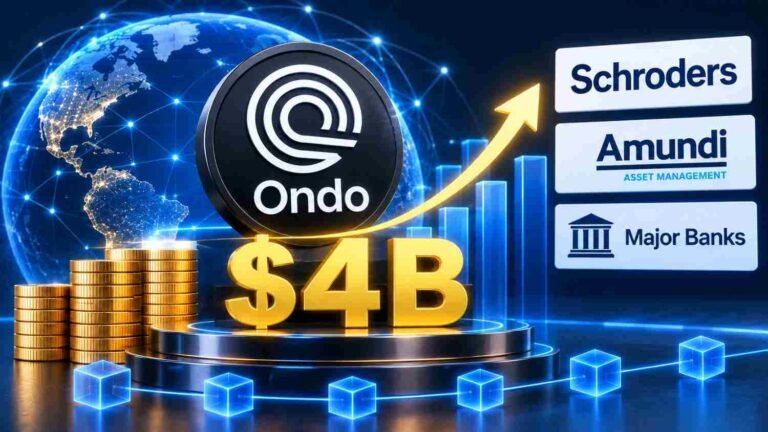
Institutional tokenization advanced this week as Ondo crossed $4 billion, Schroders launched a Solana fund, and major banks expanded blockchain adoption.
Institutional interest in blockchain finance continued growing this week as major financial companies announced important developments. New funds were launched by investment firms, digital collateral was accepted by banks, and compliance systems were enhanced by companies. In the meantime, Ondo Finance consolidated its status as the world’s largest tokenization platform.
These developments show how traditional financial companies are exploring blockchain technology. Furthermore, some of the big institutions are now introducing well-known investment products to digital networks. They have recently been active in government bonds, European stocks, emerging market debt and investment funds.
The increased activity also indicates that tokenization is transitioning out of early experimentation. Rather, financial firms are experimenting with the possibility of applying blockchain in the current markets. Here are 5 important happenings this week.
1. Schroders Launches Emerging Markets Bond Fund on Solana
Global investment firm Schroders has teamed up with Centrifuge to launch an emerging markets bond fund on Solana. The new product offers investors exposure to emerging market debt via blockchain technology.
The fund invests in accordance with the Schroder International Selection Fund Emerging Market Bond strategy. It provides investors with debt investments in developing economies. Such investments may be in government bonds, company bonds, etc.
Schroders has over $1 trillion in assets across the globe. In addition, the firm has more than 50 years of experience in investing in emerging market debt.
It has over 40 professionals dedicated to this market in its investment team. They have experience in government bonds, corporate debt and local currency investments.
This is the first time Schroders has launched on Solana. The partnership is thus an important milestone in its digital asset strategy.
2. Ondo Finance Becomes the World’s Largest Tokenization Platform
Ondo Finance has outstripped Securitize to become the world’s largest tokenization platform. RWA.xyz reports that its total value locked (TVL) has surpassed $4 billion.
This milestone marks Ondo’s rise to the forefront of the real-world asset market. There are a number of traditional financial products available on the platform via blockchain networks.
Read more: Ondo Finance Becomes World’s Largest Tokenization Platform With Over $4B TVL – Ledger Tribune
These are US Treasury securities, company stocks, exchange-traded funds (ETFs) and investment portfolios. Thus, investors can avail various financial products via its services.
The achievement also reflects the growing interest in investment opportunities based on blockchain. Ondo has been steadily growing its product line to be able to reach more investors.
Furthermore, the company is bringing together the traditional financial markets and digital investment services. The platform’s TVL is an indicator of the value locked on the platform.
The move is also a significant step in the rivalry between the leading tokenization firms. Both companies are in a market that is gaining traction with financial institutions.
But the $4 billion threshold puts Ondo in the lead on the reported TVL. The company is still pursuing the expansion of the traditional financial asset market.
3. Société Générale Accepts $10 Million in Tokenized US Treasuries
Société Générale, a French banking group, took $10 million worth of tokenized US Treasury securities as collateral. The deal was done on the Canton Network, with assets from DTCC’s Tokenization Service.
This is a development that links blockchain securities with traditional banking activities. The bank said the assets were “present in the bank’s existing collateral systems.
The deal also demonstrated that digital government bonds can be transferred from one blockchain network to another. Moreover, Société Générale carried out the process in accordance with its current risk management framework.
Collateral plays an important role in financial markets. Eligible assets are used to back loans and trading by banks and financial institutions.
The reason for this is that the US Treasury securities are very important in the global financial markets. Thus, the acceptance of tokenized versions can open up new possibilities for financial institutions.
The deal also marks a step forward for DTCC’s Tokenization Service. DTCC provides important infrastructure for clearing and settling financial transactions.
4. Amundi Brings European Stock Market Exposure to Ethereum
European investment company Amundi launched a tokenized share class of its Core STOXX Europe 600 fund. The new product runs on the public Ethereum blockchain.
The fund is based on the STOXX Europe 600 index, which is a broad-based index of the largest companies in Europe. So, investors are exposed to a wide selection of European stocks with one investment product.
The index covers companies from a number of industries and from European markets. It provides investors with access to a wider part of the regional stock market.
This launch is also the first step in Amundi’s digital asset strategy that goes beyond cash management products. In the past, it was mainly on other financial solutions that it worked on tokenization.
Furthermore, the company believes that there are opportunities to link conventional investment products to the new financial infrastructure. The new release adds a significant European equity strategy to Ethereum.
Amundi is one of the biggest asset management firms in Europe. The latest action marks the increasing institutional interest in investment services based on blockchain.
5. Major Companies Advance Blockchain Compliance Standards
Apex Group, Chainlink, T-REX Network and the ERC-3643 Association demonstrated a compliance framework for tokenized bonds.
The framework assists financial institutions in verifying the identity of investors and eligibility for investments. It also enables rules to be set for the transfer of securities between blockchain networks.
These checks are crucial since financial products have to adhere to a set of regulations. So, institutions must have a reliable system in place before they can increase their digital investment services.
The project is also compliant with Swift standards that facilitate the communication between financial institutions in the global market. In the meantime, Swift has become a member of the ERC-3643 Association to aid this effort.
Related reading: Bullish Adds Solana, Aptos and Ethereum for Tokenized Stock Services – Ledger Tribune
ERC-3643 is a standard for the issuance of securities that have compliance rules built in. It enables financial firms to put investor checks and transfer restrictions.
The new framework is designed to ensure that these rules are applicable to various blockchain networks. Consequently, financial institutions could manage digital investments more easily.
This is also a step closer towards the financial standards that are already established and blockchain technology. It may help to facilitate increased collaboration between banks, asset managers and digital infrastructure providers.
Last but not least, this week’s developments reflected ongoing interest in blockchain finance from the institutional community. Schroders and Amundi expanded investment products, while Société Générale tested digital collateral. Meanwhile, Ondo hit $4 billion in TVL, and big companies improved compliance.

I am a crypto news writer focused on blockchain updates, market trends, and digital asset developments. I write clear and simple articles that help readers understand the fast-moving crypto world.
