
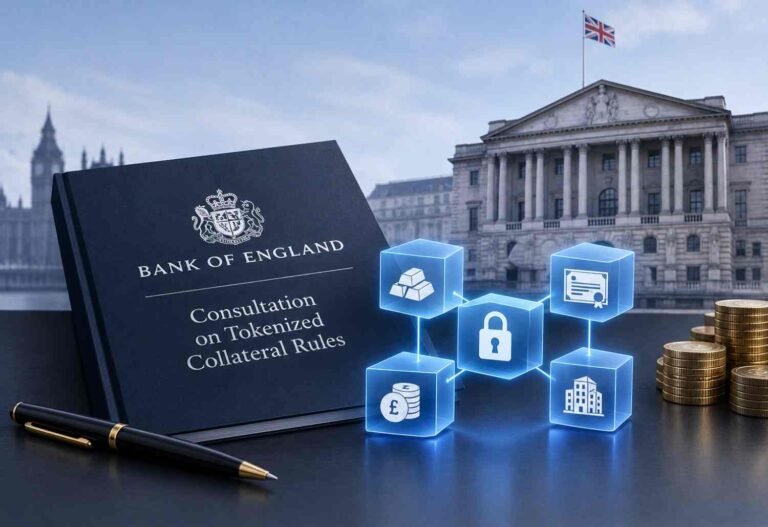
The Bank of England seeks feedback on tokenized collateral rules, aiming to support financial innovation while maintaining safety across clearing markets.
The Bank of England has opened a consultation on rules for central clearing houses accepting tokenized collateral. The proposal may facilitate the movement of assets and margin calls for financial firms more efficiently. It also seeks to encourage innovation in the financial markets in the UK.
Existing regulations do not automatically bar clearing houses from accepting tokenized assets, the central bank notes. But these assets have to meet the same standards as conventional collateral. The consultation does not therefore give blanket approval to all tokenized assets.
Bank of England Seeks Clear Rules for Tokenized Collateral
The consultation is about central counterparties, or CCPs. These institutions facilitate the risk management between the buyer and seller in financial markets. They also mandate that firms post collateral to secure transactions in case of any losses.
Related reading: Onchain Management of Tokenized Securities: How Blockchain Is Changing the Way Markets Run – Ledger Tribune
Tokenization transforms real-world assets into digital tokens that are stored on blockchain networks. Consequently, financial institutions were able to transfer and control some assets using digital systems. This process can enhance the speed and efficiency of collateral management.
The Bank of England believes tokenization may enable companies to better meet margin calls. These calls demand that financial institutions offer extra security when market conditions alter. More rapid asset transfers may assist companies to satisfy these needs in a timely fashion.
Moreover, tokenized collateral could make asset management easier across different countries. Financial institutions may have multiple markets and jurisdictions. So, better digital systems could facilitate the transfer of their assets more effectively.
The central bank also thinks tokenization will help innovation in central clearing. This is part of the UK’s broader wholesale digital financial markets agenda. Financial stability is still a key factor in the adoption of new technology, however.
Tokenized Assets Must Meet Existing Safety Standards
The Bank of England has stated that tokenized assets must meet existing collateral requirements. In particular, clearing houses should ensure these assets are appropriate in normal and adverse market conditions.
For instance, the collateral must be able to be accurately valued. It must also be transferable and available when a clearing house needs it. In addition, institutions need to be able to capture its value in times of market stress.
These requirements are designed to ensure that a change in technology does not reduce financial protections. While blockchain systems might be quicker in transferring assets, speed is not enough to make an asset acceptable. The legal arrangements and underlying asset must also comply with the standards.
The Bank’s proposed Supervisory Statement seeks to offer greater clarity. It outlines the approach the regulator would take to reviewing applications with tokenized collateral. Therefore, the need of central clearing houses and their members could be better understood prior to the introduction of such arrangements.
The proposal also adheres to the principle of “same risk, same regulatory outcome. This implies that various tokenization models can employ different technical approaches. But they still need to get the required regulatory safeguards.
The consultation is therefore about how tokenized arrangements can conform to current standards. It does not mean that all blockchain assets will be eligible. Rather, each arrangement must prove that it can control the risks associated with it.
Sarah Breeden Highlights Financial Innovation and Stability
The consultation is significant, Sarah Breeden, Deputy Governor for Financial Stability at the Bank of England, said. The proposal aligns with the Bank’s second goal of fostering innovation in financial market infrastructure, she said.
Breeden also stressed the need to maintain financial stability. She said responsible tokenization is a broader initiative that includes authorities and financial industry players.
Her remarks indicate the Bank is looking at new technology with great caution. In the meantime, the consultation provides financial companies with an opportunity to gain insight into the regulator’s expectations.
The development could become important for institutions using blockchain-based financial services. But it will be contingent on the final guidance and the application of the requirements by clearing houses.
The proposed approach, if implemented, could facilitate the integration of digital asset systems into the traditional financial system. It could also spur companies to consider tokenized collateral in their daily financial transactions.
The Bank of England is asking for input, not final approval, at this point. However, the consultation is another sign of the progress towards tokenization in regulated financial markets.

Bilal Hassan is a seasoned crypto journalist with over five years of experience covering blockchain, digital assets, and global fintech trends. His work focuses on market developments, regulatory shifts, and the evolving landscape of cryptocurrency adoption worldwide.
