
Key Takeaways
-
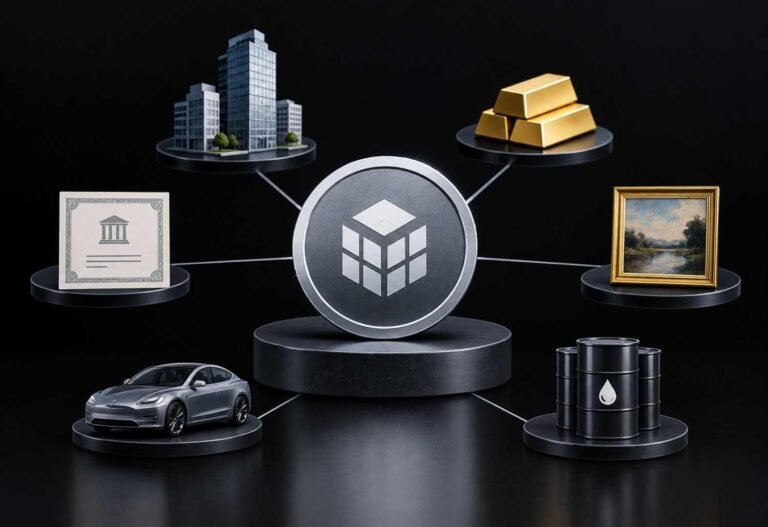
Growing Adoption: Banks and investment firms are moving traditional assets onto blockchains.
-
Treasury Funds Lead: Tokenized Treasury funds are driving adoption.
-
Tokenized Stocks: Access and ownership rights vary by platform.
-
Gold Tokens Grow: Tether Gold and Paxos Gold provide blockchain-based gold exposure.
-
Regulatory Challenges: Countries have different rules for tokenized assets.
-
Key Risks: Investors should check ownership rights, asset backing, liquidity, and redemption rules.
Introduction
Tokenization stopped being a conference slogan in 2026 and turned into a product list. In the past ten months BlackRock’s tokenized Treasury fund became tradable through Uniswap, Hong Kong listed a gold ETF with Ethereum-based units, Canada’s central bank helped issue a tokenized bond, and the US securities depository ran live trades on tokenized stocks, ETFs and Treasuries. Over the same period China banned unapproved real-world-asset tokenization, and Brazilian courts closed the land-registry door to property tokens.
This page tracks those moves in one place. Each entry carries a date, an asset type, a chain where one was disclosed, and a link to a source. Our own reading comes near the end and is labelled as analysis. We revise this page monthly.
How to read this tracker
Three ground rules keep the numbers honest. Dates are announcement dates unless we say otherwise. Market figures are snapshots from the source named beside them, so check the live dashboard before quoting them. And “tokenized” covers very different things: a money-market fund share, a bank deposit record and a token that only tracks a stock price carry different legal rights, even when all three sit on a blockchain.
Overview: the main tokenization moves of 2026
| Who | What happened | Date | Asset type | Chain / ledger | Source |
| SEC (for DTC) | Three-year no-action letter for a tokenization service | Dec 11, 2025 | Regulation | n/a | Morgan Lewis |
| BNY | Tokenized deposits for institutional clients | Jan 9, 2026 | Bank deposits | BNY’s permissioned network | PYMNTS |
| Hang Seng Investment Mgmt | Gold ETF (03170.HK) with a tokenized unit class | Jan 29, 2026 | Gold ETF | Ethereum | The Block |
| UBS | “Fast follower” tokenization strategy, 3–5 year horizon | Feb 4, 2026 | Strategy statement | n/a | The Block |
| China (PBoC and agencies) | Notice banning unapproved onshore RWA tokenization | Feb 6, 2026 | Regulation | n/a | The Block |
| Franklin Templeton + Binance | Tokenized money-market fund shares as off-exchange collateral | Feb 11, 2026 | Money-market fund | Benji platform (several public chains) | Franklin Templeton |
| BlackRock + Securitize + Uniswap Labs | BUIDL fund tradable via UniswapX for eligible investors | Feb 11, 2026 | Treasuries fund | Public chain (UniswapX) | The Block |
| Binance + Ondo | 10 tokenized US stocks and ETFs, non-US users only | Feb 24, 2026 | Equities and ETFs | Not stated in source | The Block |
| Bank of Canada, EDC, RBC, TD | Project Samara: C$100M tokenized bond trial | Mar 6, 2026 | Bond | Reportedly Hyperledger Fabric | Bank of Canada |
| Nasdaq + Börse Stuttgart (Seturion) | Nasdaq’s European venues linked to tokenized settlement | Mar 9, 2026 | Securities settlement | Public and private chains | The Block |
| Robinhood | Robinhood Chain mainnet with 24/7 Stock Tokens outside the US | Jul 1, 2026 | Equities and ETFs | Arbitrum-based Layer 2 | The Block |
| DTCC (DTC) | Live production trades of tokenized securities with 30+ firms | Jul 15, 2026 | Stocks, ETFs, Treasuries | Hyperledger Besu and Canton | PostTrade 360 |
| São Paulo courts | Registries barred from linking property title to tokens | Reported Jan 2026 | Real estate | n/a | Campos Thomaz |
Banks and asset managers
Franklin Templeton, with Binance
On February 11, Franklin Templeton and Binance went live with a program that lets eligible institutional clients pledge tokenized money-market fund shares as collateral for trading on Binance. The shares are issued through Franklin Templeton’s Benji platform and stay in regulated custody with Ceffu, a Dubai-licensed custodian, while their value is mirrored inside Binance’s trading system. The appeal is simple: traders keep earning fund yield without parking assets on an exchange. Benji already runs on several public chains, and it added BNB Chain in September 2025, The Defiant reported. Our earlier coverage: Binance and Franklin Templeton activate first joint tokenization initiative.
BlackRock, with Securitize and Uniswap Labs
Also on February 11, BlackRock, Securitize and Uniswap Labs announced that shares of BUIDL, a tokenized fund backed by US Treasuries and cash equivalents, can be traded through UniswapX. Access is not open to everyone: investors must be pre-qualified and whitelisted, and Securitize handles the compliance layer. BlackRock also bought an undisclosed amount of the UNI token. BUIDL held about $2.4 billion when the news broke. Our earlier coverage: BlackRock and Securitize bring tokenized Treasuries to Uniswap.
UBS
UBS made the least dramatic announcement and perhaps the most telling one. On its February 4 earnings call, CEO Sergio Ermotti described the bank’s approach to tokenized assets as a “fast follower” strategy, with a rollout spread over three to five years and alongside plans for client crypto access. The bank builds on its UBS Tokenize platform and its earlier uMINT tokenized money-market fund on Ethereum. Our earlier coverage: UBS adopts fast-follower strategy in asset tokenization push.
BNY
On January 9, BNY enabled on-chain mirrored balances of client deposits on its Digital Assets platform and called it the first step in tokenizing deposits. These are digital entries tied one-to-one to deposit claims clients already hold at the bank, not newly created money, and they run on BNY’s own permissioned network. The first use cases are collateral and margin. ICE and Ripple Prime were among the firms that publicly welcomed the launch. Our earlier coverage: BNY Mellon unveils 2026 roadmap focused on tokenized deposits.
Hang Seng Investment Management
The Hang Seng Gold ETF (03170.HK) listed on January 29. It tracks the LBMA Gold Price AM, holds physical gold in Hong Kong vaults, and offers a second class of tokenized units issued on Ethereum, with HSBC acting as tokenization agent. The tokenized units can be subscribed to or redeemed only through eligible distributors, and no secondary market exists for them. Our earlier coverage: Hang Seng launches gold ETF with Ethereum-based tokenized shares.
Bank of Canada
On March 6 the Bank of Canada announced that Project Samara, a trial with Export Development Canada, RBC and TD, had completed. EDC issued a C$100 million tokenized bond to a closed group of investors, and trades settled in tokenized wholesale central-bank money. The platform was reportedly built on Hyperledger Fabric, and the bank was cautious about how quickly wider adoption could follow. Our earlier coverage: Bank of Canada successfully tests tokenized bond technology.
Exchanges, brokers and market infrastructure
Binance and Ondo
On February 24 Binance returned to tokenized stocks, its first such offering since it shut down an earlier program in 2021. Ten tokenized US stocks and ETFs from Ondo, including Apple, Alphabet, Tesla, Nvidia and the Invesco QQQ fund, were added to Binance Alpha and Binance Wallet. They are not available to US users. OKX had reportedly announced a similar move with Ondo days earlier. Our earlier coverage: Binance relaunches tokenized US stocks and ETFs with Ondo Finance.
Robinhood
Robinhood launched tokenized stocks for European customers in June 2025 and said on January 28 that it would add 24/7 trading and self-custody, The Block reported. Its own Layer 2 network, Robinhood Chain, built on Arbitrum technology, reached mainnet on July 1, with 24/7 Stock Tokens offered in more than 120 countries. The US was not one of them. Our earlier coverage: Robinhood pushes tokenized stocks with 24/7 trading.
Nasdaq and Börse Stuttgart
On March 9, Nasdaq announced a partnership with Seturion, the tokenized-settlement platform Börse Stuttgart Group launched in September 2025. The deal connects Nasdaq’s European trading venues to Seturion, which settles on both public and private blockchains, and targets fragmented post-trade systems in Europe. Our earlier coverage: Nasdaq and Börse Stuttgart join forces for tokenized asset settlement.
DTCC
The biggest institutional signal of the year came from the plumbing. On December 11, 2025, SEC staff gave the Depository Trust Company, a DTCC subsidiary, a three-year no-action letter covering a defined tokenization service. On July 15, DTCC ran live production trades with DTC-tokenized assets involving more than 30 firms, covering collateral pledges, securities lending and US stocks, ETFs and Treasuries, on Hyperledger Besu (its private network) and Canton (a public one). DTCC’s announcement put the commercial launch in October 2026; we have not confirmed the go-live as of this update, so check DTCC’s newsroom. Law firm Morgan Lewis notes the letter covers DTC’s service only and does not create a general framework for tokenized securities.
Tokenized gold and Treasuries: the numbers
Treasuries. rwa.xyz data, as summarized by Eco, put tokenized US Treasuries and money-market funds at $15.65 billion across 101 funds on September 15. The largest were BlackRock’s BUIDL ($2.70 billion), Circle’s USYC ($2.60 billion), Ondo’s USDY ($2.23 billion) and Franklin Templeton’s iBENJI ($1.70 billion). The same snapshot showed total distributed RWA value of $38.82 billion. In the 30 days before it, Treasury tokens fell 3.46% while tokenized stocks rose 17.36%. Our earlier tracking: Tokenized US Treasuries cross $10.13B.
Gold. Tokenized gold passed $6 billion in February, up about $2 billion since the start of the year, according to Token Terminal data. Tether Gold (XAUT) stood near $3.6 billion and Paxos Gold (PAXG) near $2.3 billion, together roughly 97% of the sector. Gold was trading near $5,000 an ounce then, so part of that growth is price, not new tokens. We could not confirm a newer sector total for this update. Our earlier coverage: Tokenized gold market surpasses $6 billion.
Regulation: three different answers
United States: narrow permission. The December 2025 no-action letter lets DTC run its tokenization service for three years under conditions. SEC officials have said tokenized securities are still securities, and Chair Paul Atkins has pushed an “innovation exemption” that could work as a sandbox; we have not confirmed whether it has been finalized.
China: a ban with a possible carve-out. On February 6 the People’s Bank of China and other agencies issued a notice that treats unapproved onshore RWA tokenization as prohibited, requires strict vetting of offshore tokens backed by Chinese onshore assets, and bars unapproved offshore yuan-pegged stablecoins. Reuters noted that some read it as the start of a legal framework for approved activity. Our earlier coverage: China expands crypto ban, cracks down on RWA tokenization.
Brazil: the land registry says no. São Paulo’s Provimento 54/2025 forbids registry officers from making entries that tie property ownership to digital tokens, and courts in Rio Grande do Sul, Santa Catarina, Mato Grosso do Sul and Espírito Santo adopted similar limits, according to law firm Campos Thomaz. The national registry operator argues that property rights must be created inside the formal registry. Our earlier coverage: Brazil regulator pauses tokenized real estate listings in São Paulo.
Our analysis
This section is our opinion, not reporting.
The proven use case is cash and collateral
About 40% of the $38.82 billion in distributed value is tokenized Treasury products, and gold adds several billion more. The big launches share a pattern: Franklin Templeton fund shares as Binance collateral, BUIDL on UniswapX, DTCC’s collateral pledges, BNY deposits aimed at margin. All of them move safe, yield-bearing assets around outside banking hours. That is a real problem being solved, and it is far less glamorous than “everything on-chain.”
“Open” usually means gated
Hang Seng’s tokenized units have no secondary market. BUIDL on UniswapX is for whitelisted, pre-qualified investors. BNY runs on a permissioned network. Binance’s Ondo stocks exclude US users. The blockchain is the easy part; the access controls are what let regulated firms take part. Expect tokens that look like DeFi and behave like private placements.
Plumbing matters more than products
A single token launch moves little. DTCC, Nasdaq with Seturion, and the Bank of Canada’s trial change how ordinary securities settle, so we weigh them more heavily. But none of the sources we reviewed published volumes for these efforts, so for now they are credible pilots, not proof of scale.
Where marketing runs ahead
Be careful with three things. First, market-size headlines: the same dashboard showed $38.82 billion distributed and $364.76 billion represented, and the gap is methodology, not growth. Second, “tokenized stock” can mean different structures; in some, holders get price exposure through a tracking token without a shareholder’s rights, so read the issuer’s terms. Third, “first” claims: Binance’s February launch was a return, not a debut.
What we are watching
DTCC’s volumes after launch; whether the SEC finalizes its innovation exemption; whether Treasury-token balances resume growth after September’s dip; and the timing of any US launch of 24/7 tokenized stocks.
A four-question test for any tokenized product
- What exactly do I own: a fund share, a claim on the issuer, or only price exposure?
- Who holds the underlying asset, and who audits it?
- Can I redeem, and where can I sell if the platform closes?
- Which regulator oversees the issuer, and does my country allow me to buy it?
FAQ
What is a tokenized asset?
A token that represents a claim on something that exists outside the blockchain, such as a fund share, a bond or gold. What you actually own depends on the legal structure behind the token.
Are tokenized stocks the same as real shares?
Not necessarily. Some structures carry shareholder rights, while others give price exposure only. Check the issuer’s terms and whether your country is allowed access; the Ondo stocks on Binance and Robinhood’s Stock Tokens are not offered in the US.
Is tokenized gold safe?
It depends on the issuer, the vault and the audits. XAUT is reported to be backed by allocated gold in Swiss vaults, and PAXG is issued by Paxos. Both rely on a custodian doing its job, and two issuers make up about 97% of the market.
Can US retail investors buy tokenized stocks today?
Not through the products covered here. Ondo’s stocks on Binance and Robinhood’s Stock Tokens exclude the US, and a Robinhood US launch is only reported for 2027. DTCC’s service is infrastructure for institutions’ existing holdings, not a retail app.
What changes if DTCC’s service is fully live?
Eligible DTC participants can hold tokenized versions of assets already in DTC custody, with the same entitlements and protections, and move them between registered wallets on approved chains. Most investors will not see the change directly.
Update log
- Oct 27, 2026: First publication. Added the overview table, institution profiles, regulation summary and analysis.
More from Ledger Tribune
- Tokenized assets weekly report: banks, exchanges and regulators expand blockchain finance
- Wall Street accelerates tokenization push with major institutional moves
- 21Shares targets tokenized assets with Ondo ETF filing
- UAE firm tokenizes $280M diamonds on XRP Ledger in record deal
- White House predicts tokenization boom, XRP Ledger gains spotlight
- Binance and OKX race to launch tokenized US stocks
Sources, corrections and disclaimer
Figures come from the linked sources and were checked on October 27, 2026. If you spot an error, email hello@ledgertribune.com and we will correct it and note the change in the update log. This page is for information only and is not investment, legal or tax advice.

Bilal Hassan is a seasoned crypto journalist with over five years of experience covering blockchain, digital assets, and global fintech trends. His work focuses on market developments, regulatory shifts, and the evolving landscape of cryptocurrency adoption worldwide.
