
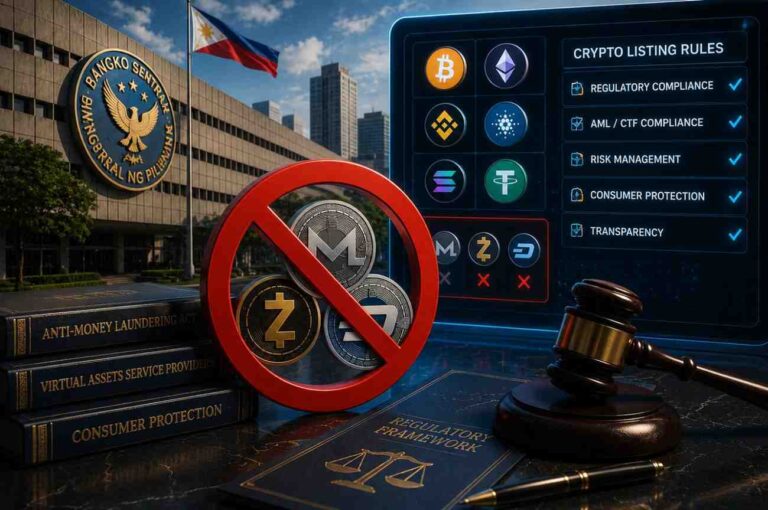
Philippine Central Bank bans privacy coins and introduces stricter token listing, monitoring, and delisting requirements for crypto firms.
The Bangko Sentral ng Pilipinas (BSP), the central bank of the Philippines, has introduced stricter rules for virtual asset service providers (VASPs). The new guidelines mandate that crypto platforms tighten up their token listing, monitoring and delisting processes. Moreover, the regulator has explicitly banned VASPs from listing and supporting privacy-oriented virtual assets.
According to The Philippine Star, the move is part of a series of measures taken by regulators to tighten their grip on the digital asset sector. This means that crypto businesses in the Philippines are required to adhere to more rigorous compliance requirements when selling cryptocurrencies and tokens to consumers. These measures are intended to enhance transparency, investor protection and market stability, the BSP said.
Why Has the BSP Banned Privacy-Enhancing Virtual Assets?
One of the most important parts of the new memorandum is the ban on anonymity-enhancing virtual assets, commonly known as privacy coins. These digital assets are meant to conceal details of transactions and users.
Philippine Central Bank Bars VASPs From Listing Privacy-Enhancing Virtual Assets
According to The Philippine Star, the Bangko Sentral ng Pilipinas (BSP) has explicitly prohibited virtual asset service providers (VASPs) from listing or supporting anonymity-enhancing, or privacy,… pic.twitter.com/yAl47Aalha
— Wu Blockchain (@WuBlockchain) June 14, 2026
The BSP states that privacy-oriented assets are not allowed to be listed or supported by licensed VASPs. As such, crypto platforms should make sure that such assets are not traded on their platforms.
The central bank did not mention any privacy coins. But the move is part of a broader trend of international worry over anti-money laundering regulations and financial transparency. In many countries, regulators have expressed worries that privacy coins can complicate transaction tracking.
This is why the BSP is looking for more transparency and traceability in assets offered by crypto platforms. The regulator is convinced that this will contribute to lowering risks associated with illegal financial activities and enhance customer protection.
What New Requirements Must Crypto Platforms Follow?
The BSP has directed VASPs to have a strong due diligence procedure prior to listing any virtual asset. Thus, crypto businesses need to thoroughly examine every token prior to offering it to customers.
The regulator identified six areas to be assessed. These include the background of the issuer, maturity of the market, use cases, transparency, security, liquidity, reserves, and legal compliance.
VASPs can check the business documents, ownership, financial statements, and management history, for instance. They also can review potential conflicts of interest between issuers, regulators, or related parties.
The BSP also desires platforms to analyze market data. This encompasses market capitalization, trading volume, years of operation, number of token holders, and exchange support. As a result, only assets with stronger fundamentals may qualify for listing.
Moreover, crypto companies are required to give their customers information about every asset. Whitepapers should be readily accessible and contain information on project objectives, token economics, supported blockchains, and risks.
Security is also a key concern, the regulator said. Thus, VASPs can check blockchain technology, consensus mechanisms, interoperability, independent audits, and blockchain analytics before approving a token.
How Will the New Delisting Rules Work?
The BSP is not only focusing on token listings. It also calls for ongoing monitoring of listed assets. Therefore, crypto platforms must regularly review whether a token still meets listing standards.
VASPs will be required to set thresholds that will lead to suspension or delisting under the new rules. Platforms may have to withdraw a token from trading if it does not comply with the requirements.
The regulator cited a number of grounds for suspension or delisting. These include legal breaches, cyber security issues, consumer protection concerns, misleading disclosures, market abuse and abnormal price movements.
In addition, adverse economic or market developments may also trigger a review. As a result, platforms will need stronger risk management systems to monitor listed assets.
The BSP imposed extra requirements for stablecoins and asset-backed tokens. Crypto companies need to assess the backing of their reserves, redemption policies, liquidity providers, and asset management procedures. These measures are designed to help these tokens to remain stable and to satisfy redemption requirements.
In conclusion, the BSP’s new directive is a major stride toward enhancing the regulation of cryptocurrencies in the Philippines. The central bank’s measures are designed to make the digital asset market safer and more transparent, while also eliminating privacy coins and improving the listing criteria. With the crypto industry continually changing, regulators are increasingly focusing on compliance, security, and investor protection.

Bilal Hassan is a seasoned crypto journalist with over five years of experience covering blockchain, digital assets, and global fintech trends. His work focuses on market developments, regulatory shifts, and the evolving landscape of cryptocurrency adoption worldwide.