
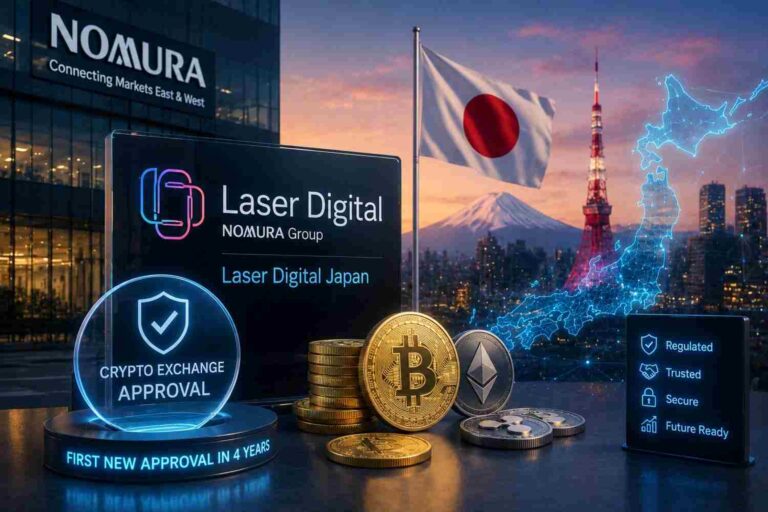
Laser Digital Japan crypto exchange gains approval, marking Japan’s first new crypto exchange registration in 4 years and expanding institutional access.
Nomura-backed Laser Digital Japan has secured approval as Japan’s newest crypto asset exchange provider since 2022. The approval is a significant milestone for the emerging digital asset market in Japan. Furthermore, the company will prioritize serving local crypto companies over institutional investors. The transfer is also coinciding with a tightening of crypto and traditional finance regulations in Japan.
Laser Digital Japan Receives Key Crypto Exchange Registration
Laser Digital Japan is supported by Nomura Securities and part of the Laser Digital group. The company has been registered as a Crypto Asset Exchange Service Provider by Japan’s Financial Services Agency. Therefore, Laser Digital Japan can legally operate under Japan’s Payment Services Act.
Laser Digital Japan is now registered under Japan’s Payment Services Act, the country’s first new Crypto Asset Exchange Service Provider registration in four yearshttps://t.co/v4Ha0VWZr0
— Laser Digital (@LaserDigital_) August 21, 2026
The company will initially offer liquidity services to virtual asset service providers in the country. This role may facilitate the local cryptocurrency companies to gain access to deeper and more reliable liquidity in the market. Laser Digital Japan, however, is not only looking to support liquidity but is also looking to expand its service.
Later, the company expects to offer digital asset trading services to institutional investors. The company has yet to reveal the launch date or specific trading services. So, investors will have to wait for more information from the company.
Laser Digital Japan stated that compliance is still a key aspect of their business. It also has risk management and governance systems in place which conform to international standards. Therefore, the company will try to establish trust among Japanese institutions and market participants.
Laser Digital’s Co-founder and Executive Chairman Steve Ashley welcomed the registration. He stated that institutional interest in digital assets is still growing in global markets. He also raised the need for robust infrastructure and market access.
In the meantime, Laser Digital’s CEO Jez Mohideen said Japan’s market was going through a new phase. He noted that trusted counterparties and appropriate digital asset infrastructure have become a necessity for institutional investors.
Also, Hideaki Kudo, the head of Laser Digital Japan, pointed out that the regulatory process is lengthy. The company’s compliance and investor protection remain its focus, he added.
Laser Digital Japan is the first new registered crypto exchange in Japan since 2022 with the approval. The development, therefore, may mark a new era for the Japanese digital asset market.
Japan Strengthens Crypto Rules and Institutional Access
Over the past few years, Japan has gradually shifted its stance on digital assets. At first, regulators had given a lot of attention to consumer protection and market security. But, there have been more recent changes that indicate greater interest in institutional crypto adoption.
In July 2026, Japan revised its Financial Instruments and Exchange Act. The changes categorize crypto assets as financial products and not merely as payment instruments. So, the reforms may pave the way for future crypto investment products.
The modifications also bring in more robust market conduct standards for digital assets. These rules contain provisions on disclosure and insider trading. With this in mind, Japan is moving the crypto markets towards traditional financial markets.
Japan’s crypto strategy is also gaining a new dimension with tax reforms. The nation has been mulling a separate 20% tax rate on cryptocurrencies. In the past, crypto gains were subject to much higher rates under the miscellaneous income rules.
Japan has also put in place a regulated framework for stablecoins. Under this framework, financial institutions and trust companies can help facilitate stablecoin operations. This means that stablecoins may become a new bridge between the crypto and traditional financial worlds.
Demand is also rising in Japan among institutions. Japanese institutions were highly interested in the survey, which was conducted by Nomura and Laser Digital in 2026. According to the survey, 79% would invest in crypto assets in the next 3 years.
Laser Digital Approval Could Boost Japan’s Crypto Market
The new registration might bolster Japan’s standing in the Asian digital asset industry. With the existing regulatory framework in Japan, Laser Digital Japan is now able to establish local operations. This might also make it easier for institutional investors to obtain regulated crypto services.
Another crucial tie-up with the traditional finance world is Nomura’s link. Laser Digital may be able to merge the world’s digital asset expertise with Japan’s financial system.
In the meantime, other Japanese financial institutions are looking into crypto opportunities. Other firms interested in digital assets include Daiwa Securities Group and SMBC Nikko Securities. Their involvement may lead to more competition and institutional activity.
The increase in asset ownership has also positively impacted Japan’s crypto market. Domestic investors reportedly have more than 5 trillion yen of crypto assets. Therefore, stronger regulation could support a larger and more mature market.
The anticipated rise in the number of crypto exchange-traded funds (ETFs) may also drive more institutional interest. The financial reforms in Japan could also eventually benefit products associated with the major cryptocurrencies. But the approvals and launch dates of certain ETFs are still pending.
Liquidity services is the priority for Laser Digital Japan. Later, the company will evaluate its institutional trading plans and market opportunities. Thus, its initial clearance might be the start of a wider rollout.

Bilal Hassan is a seasoned crypto journalist with over five years of experience covering blockchain, digital assets, and global fintech trends. His work focuses on market developments, regulatory shifts, and the evolving landscape of cryptocurrency adoption worldwide.