
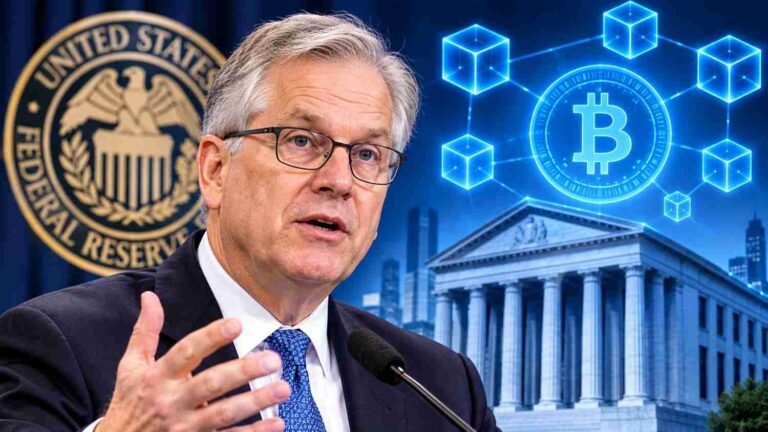
Fed Governor Chris Waller says blockchain and tokenization are challenging traditional payment systems, while highlighting security, accountability, and settlement concerns.
Federal Reserve Governor Christopher Waller says traditional payment companies are facing growing competition. He feels that stablecoins and tokenized assets are transforming the financial services industry. Furthermore, new payment providers are threatening the traditional banks with innovative financial technologies.
Speaking at The Clearing House’s annual conference, Waller discussed the future of financial payments. According to crypto journalist Eleanor Terret, he said traditional banks need to adjust to the growing competition. He does not anticipate that other payment systems will supplant the current infrastructure, though, he believes they will coexist.
Chris Waller Says New Payment Companies Challenge Traditional Banks
Waller explained the impact of open networks on competition in financial markets. In the past, banks had a dominant role in the payment system and services. But now, new businesses can create payment solutions without having to construct traditional systems.
Moreover, the latest development tools make it easier for fintech businesses to launch financial services. As a result, existing financial institutions are under greater pressure to enhance their services.
Read more: UK, Singapore and Thailand Test Cross-Border Tokenized Currency Settlement System – Ledger Tribune
Banks are reacting in various ways, however, with different development strategies. Some institutions are developing private networks and others are participating in industry partnerships. In addition, some banks are collaborating with tech firms to develop new payment options.
Waller believes that stablecoins, tokenized bank deposits and tokenized money market funds will all coexist. Traditional payment networks will also continue to play a significant role in the financial system. Therefore, businesses may select different instruments according to their requirements.
For instance, corporate treasurers can select payment methods depending on the liquidity requirements. Likewise, asset managers might take into account regulation, settlement speed, and monetary expenses. Consequently, various payment technologies can be used for different functions.
The strategy is that new financial technologies will not replace traditional banking services. Rather, greater competition might spur institutions to create more robust payment systems.
Federal Reserve Infrastructure Remains Important for Tokenized Finance
While acknowledging the need for innovation, Waller stressed the need for central bank infrastructure. He said the traditional payment networks still play a vital role in the final settlement. The central bank money will remain in use for transactions between financial institutions.
Furthermore, these systems offer valuable linkages between conventional finance and tokenized markets. There is a need for businesses to be able to move funds from one banking system to another and from one digital network to another. Hence, the current financial system will still play a crucial role in this transition.
Waller also spoke about the Federal Reserve’s plan for “limited-purpose skinny master accounts. These accounts may enable qualified fintech and cryptocurrency businesses to gain access to payment settlement services.
The proposal might generate more chances for financial technology firms. However, they would be subject to eligibility criteria and restrictions on operation.
Waller also pointed to security and accountability issues in tokenized financial markets. When talking about possible financial risks, he referred to the Binance hack, which resulted in the loss of $6.3 billion. Moreover, he expressed concerns on fraud, lost private keys, and vulnerabilities of smart contracts.
Another issue is the assets stuck on inactive blockchain networks. These networks, also known as zombie chains, may pose problems for investors. As a result, financial institutions need to have clear responsibilities in the event of a technical failure.
Waller says the industry must have more robust protections before tokenization can take off. Businesses need to define who is responsible for the loss of access. Similarly, developers and financial institutions need clear arrangements for handling security failures.

Bilal Hassan is a seasoned crypto journalist with over five years of experience covering blockchain, digital assets, and global fintech trends. His work focuses on market developments, regulatory shifts, and the evolving landscape of cryptocurrency adoption worldwide.
