

Morgan Stanley selects BNY Mellon and Coinbase for Bitcoin ETF custody, boosting institutional crypto adoption and secure spot Bitcoin exposure.
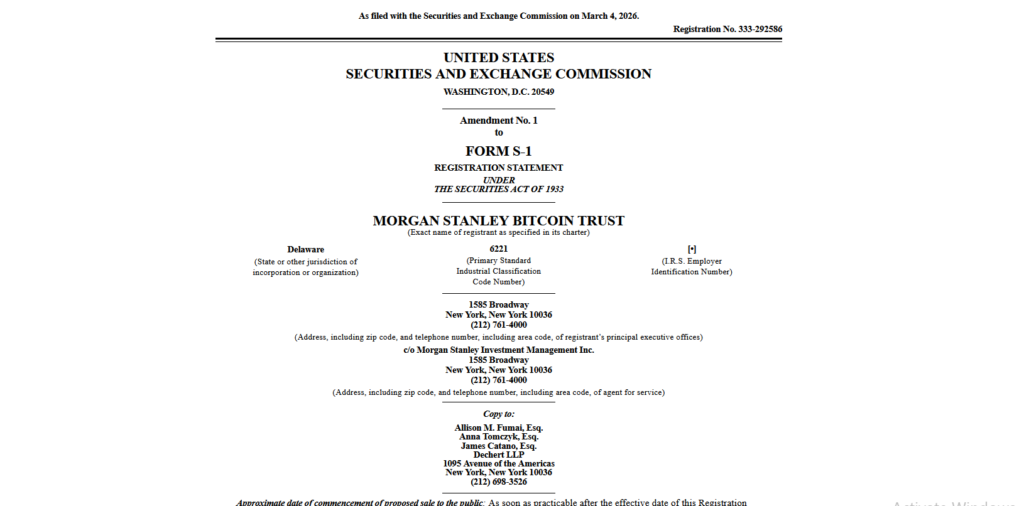
Morgan Stanley has taken a major step into crypto investing. The firm had chosen BNY Mellon and Coinbase for its Bitcoin ETF custody. The decision was included in an amended S-1 filing with the SEC, on March 4, 2026. Therefore, the move represents greater Wall Street interests in cryptocurrency, namely Bitcoin.
Coinbase and BNY Mellon Take Key Custody Roles
According to the filing with the US Securities and Exchange Commission, Coinbase Custody Trust Company will be the primary Bitcoin custodian. Any digital assets belonging to the trust will be protected by the company in segregated accounts. As a result, client assets will be kept separate from company funds.
JUST IN: 🇺🇸 Morgan Stanley issues new SEC filing for a spot Bitcoin ETF, announcing Coinbase and BNY Mellon as the custodians 👀 pic.twitter.com/52UCwS7geu
— Bitcoin Magazine (@BitcoinMagazine) March 4, 2026
Meanwhile, BNY Mellon will serve as co-custodian and administrator. The bank will also handle important back office tasks. These include fund accounting, shareholder record keeping, and transfer agent services.
In addition, BNY Mellon will act as a cash custodian. The bank will handle the flows of fiat currencies related to the operation of ETFs. Therefore, it will take care of money coming in and out of the fund.
Morgan Stanley structured the trust to hold Bitcoin directly. This means that the ETF will purchase spot Bitcoin and not futures contracts. As a result, investors will be getting direct price exposure.
The trust hopes to monitor the CoinDesk Bitcoin Benchmark. Specifically, it will be based on the 4 PM New York settlement rate. The ETF price will therefore closely track the value of Bitcoin in the daily market.
If regulators again greenlight the proposal, the ETF plans to list on NYSE Arca. This exchange already lists a number of crypto-related products. Therefore, listing there would have a good market visibility.
Cold Storage Plan to Reduce Security Risks
Security is a major concern for digital assets. For this reason, most of the Bitcoin will remain in cold storage. Cold storage avoids keeping private keys online and in contact with the internet.
However, a small percentage of Bitcoin will go to hot wallets. These wallets connect themselves to the internet for operational necessities. For instance, they support creation and redemption of ETF shares.
This structure balances with safety and liquidity. Cold storage helps to reduce hacking risks Meanwhile, hot wallets provide a smooth trading activity.
The filing described how Coinbase Custody will be responsible for digital asset protection. The firm already offers custody services for the institutions. Therefore, Morgan Stanley decided to go for an experienced crypto partner.
BNY Mellon will take care of the traditional banking tasks. The bank has been in operation for more than 200 years. As a result, it brings profound financial experience to the ETF structure.
That’s not leverage that Morgan Stanley’s Bitcoin Trust will not employ. It will also avoid complex derivatives. Instead, it will be holding Bitcoin directly in secure vaults. As a result, the objective of the fund is clear and simple exposure.
What This Means for Bitcoin Investors
This development indicates increasing institutional adoption of Bitcoin. Morgan Stanley is one of America’s largest asset managers. Therefore, its entry has a strong symbolism value.
Often, investors are drawn to ETFs because they trade like stocks. They do not need private wallets or crypto exchanges. Thus, a spot bitcoin ETF can attract new retail and institutional investors.
The partnership also demonstrates cooperation between the crypto firms and the traditional banks. Coinbase brings the expertise of blockchain. Meanwhile, BNY Mellon offers the financial systems that are already there.
If approved, the ETF would likely boost the demand of Bitcoin. More buying pressure might affect market prices in the long run. However, price movements will still be affected by supply, demand and global conditions.
The SEC has to review the filing and approve it. Only then can the ETF start trading on a public basis. Until that occurs, investors need to wait for regulatory clearance.
Overall, Morgan Stanley’s custody decisions reflect confidence in regulated crypto infrastructure. The combination of Coinbase Custody and BNY Mellon combines digital security with the strength of banking. Therefore, this ETF could become another milestone in the journey of Bitcoin to become mainstream finance.