
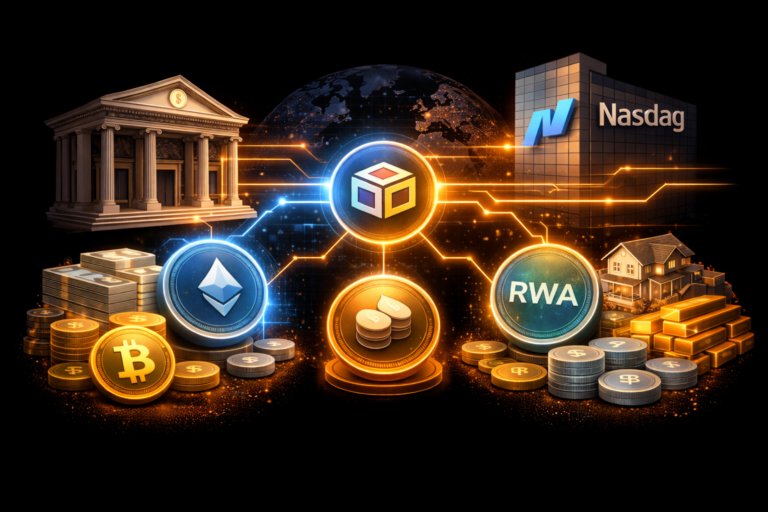
Tokenization advances this week as Nasdaq, HSBC, Standard Chartered, and regulators expand RWAs and tokenized stocks adoption across finance and global markets.
Tokenization continued gaining momentum across global finance this week. Major institutions introduced new plans involving tokenized stocks, stablecoins and digital commodities trading. At the same time, regulators gave signs of potential policy support for tokenized securities. These developments indicate that real world asset tokenization is moving closer to mainstream financial markets.
Nasdaq Moves Toward Tokenized Stock Trading
Nasdaq announced advances on a new framework for tokenized equities. The plan enables companies to sponsored blockchain tokens of their shares. These tokens would fit into official share registries. Therefore, tokenized shares would have the same legal status as traditional stocks.
Related Reading: What Is Asset Tokenization on Blockchain? Fundamentals and How It Works – Ledger Tribune
The initiative includes partnerships with the company Kraken and its parent company Payward. Together they hope to build a system that will allow tokenized stocks to trade 24/7. This approach is conducive to a future in which stock trading takes place every hour of the day.
Traditional stock exchanges usually only work during the capital hours. However, continuous transactions are possible with blockchain systems. Because of this, Nasdaq would like to introduce “always-on” trading. Investors were able to buy or sell shares at any time rather than having to wait for the market openings.
Nasdaq also intends on having strict regulatory compliance. Tokenized shares would be subject to the same rules that are applied to traditional securities. This structure is beneficial in terms of protecting the rights of investors and maintaining records of ownership. Regulators want tokenized assets to have the equivalent of existing financial laws.
The system will also allow the companies to maintain control over the tokens. Public firms will sponsor and control the tokens for their shares. This is an issuer-centric approach, which makes sure that the rights of governance remain with the companies themselves.
Nasdaq is expecting the tokenized equity system to be live around 2027. If it is successful, it could help modernize shareholder services and settlement processes. It may also minimize the delay between trades and final ownership records.
Hong Kong Banks Prepare Stablecoin Launch
Large banks are now moving into the tokenization space via stablecoins as well. Reports said the Hong Kong Monetary Authority could soon see its first stablecoin licenses. The announcement might come close to March 24 as per industry reports.
Two big banks are supposed to receive early approval. These banks are HSBC and Standard Chartered. Both banks are already issuing Hong Kong currency notes in addition to the company Bank of China (Hong Kong).
Stablecoin licensing was previously expressed by over 70 companies. After review, some 36 firms submitted formal applications. Regulators are currently considering those requests under Hong Kong’s new framework.
Standard Chartered was already a participant in the stablecoin sandbox program in Hong Kong. The sandbox enables companies to test digital payment technologies under supervision by the regulator. This program supports the authorities to study the risks before giving out full licenses.
Standard Chartered also built a joint venture with Animoca Brands and the company HKT. The partnership centers on the development of stablecoins and services in digital finance.
Stablecoins are tokens that are backed by traditional assets like national currencies. Because they have stable value they have seen a wide range of applications for payments and digital trading. Governments now see them as part of financial infrastructure in the future.
Hong Kong hopes stablecoins will give it a leg up on being the global financial center. The initiative might attract technology companies and international investors. If the licenses are granted, that city could become one of the first regulated stablecoin markets.
SEC Signals Possible Exemption for Tokenized Securities
Regulators in the United States also discussed tokenization this week. U.S. Securities and Exchange Commission chairman Paul Atkins said the agency may consider a special exemption for tokenized securities.
He made the remarks at a meeting of the Investor Advisory Committee in Washington. According to him, exemption could be used to provide limited trading opportunities for certain tokenized securities. This approach would promote innovation while retaining regulatory oversight.
The SEC often manages securities such as stocks and bonds. However, blockchain-based versions of these assets raise new legal questions. Regulators therefore want to run tests on new models, before approving full market adoption.
A regulatory exemption would possibly enable companies to try out tokenized securities in a controlled setting. This method helps regulators to see the risks and benefits before expanding the framework.
Many financial companies are in favor of the clearer rules around digital assets. Without clear regulations, firms are reluctant to launch new investment products for the tokenized. Therefore, policies could change to boost development in the sector.
The SEC’s discussion is an indicator of increasing interest from the regulators towards blockchain finance. Although the exemption proposal is still under review, it indicates that regulators are paying more attention to tokenization.
Tokenized Commodity Trading Expands in Crypto Markets
Tokenization is also penetrating commodity markets. A report from The Wall Street Journal featured new digital trading models in oil futures.
The crypto exchange Hyperliquid now uses perpetual futures contracts that are linked to oil prices. These contracts follow benchmarks like West Texas Intermediate crude.
Traditional commodity futures are only traded during market hours. In contrast, blockchain-based contracts are continuously running. Traders can therefore speculate on the price changes at any time of the week.
This structure allows crypto traders to have advanced access to market movements. For example, traders can react immediately to geopolitical events that have an impact on oil prices. Traditional investors have to wait until futures markets reopen.
Perpetual futures are a special kind of a derivative contract. Unlike normal futures, they have no expiration date. Traders hold open positions as long as they hold margin requirements.
Although these products are still very speculative they show tokenization potential. Digital contracts could one day make it possible to trade continuously for a wide variety of asset classes.
Financial experts think that tokenized stocks can help bridge traditional and digital finance. Over time, investors are allowed to trade stocks, bonds, and commodities on the same blockchain systems.
Tokenization Could Unlock Lending in Emerging Markets
Beyond trading markets, tokenization may also be useful in enabling businesses to access financing. A new report from the World Economic Forum explored how tokenized assets might help to facilitate better lending in developing economies.
Many small businesses are not able to get credit from traditional banks. These companies are referred to as micro, small, and medium-sized enterprise or MSME. They form the backbone of numerous economies.
MSMEs account for nearly 90% of businesses on the globe. They also create over half of world employment. In spite of this importance, approximately 70% of them lack of adequate financing.
The World Economic Forum has estimated that there is a global financing gap of approximately $5.2T for formal MSMEs. Informal businesses are another $2.9T behind. Because of this shortage, many companies are not able to expand the operation.
Tokenization may help solve this problem through putting real-world assets on blockchain networks. Businesses could tokenize equipment, property or invoices. Investors could then supply capital with the help of these assets as collateral.
This system would spread financing beyond the domestic banking networks. Global investors could support the businesses directly through digital platforms. As a result, companies in developing countries may have even greater access to capital.
The report also noted that around 79% of adults in the world now have bank accounts. However, access to capital continues to be a big challenge. Even the accounted people often have a hard time in obtaining emergency funding.
Tokenized stocks may therefore become a strong tool for financial inclusion. By digitizing collateral, blockchain technology has the potential to open up new lending opportunities across emerging markets.
Tokenization Moves Closer to Mainstream Adoption
Overall, this week’s developments illustrate the movement of tokenization across a number of sectors. Stock exchanges, banks, regulators and global organizations are looking at new applications.
Nasdaq’s tokenized stock framework shows us how traditional markets may change. Meanwhile, stablecoin licensing in Hong Kong signals support from major banks. At the same time, regulators in the United States are considering some policies that might promote innovation.
Commodity markets and global lending systems are also experimenting with blockchain-based assets. Each initiative increases the possible role of tokenization in the finance domain.
These developments make tokenized real-world assets a potential major financial infrastructure soon. If adoption continues, digital asset markets may merge more closely with traditional finance systems.
For now, the institutions are still testing and perfecting these technologies. However, the speed at which announcements come out demonstrates tokenization well on its way to becoming a mainstream element of the world.