
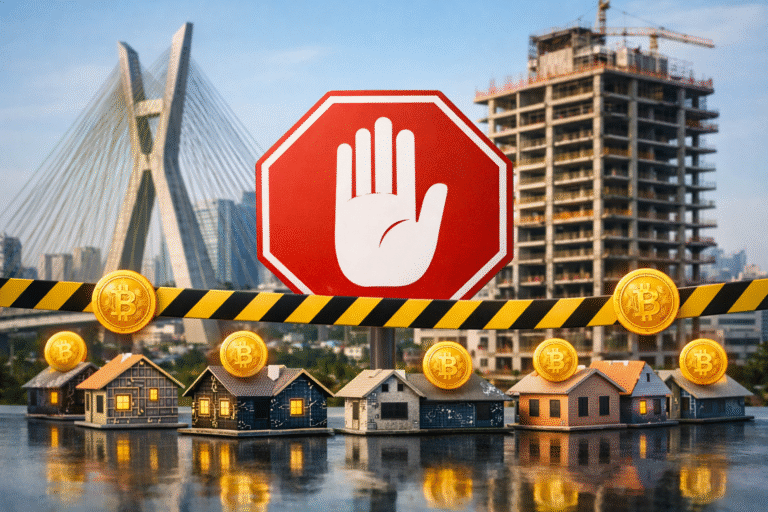
São Paulo halts tokenized real estate registrations as regulators cite legal gaps, raising uncertainty for Brazil’s blockchain property market.
Brazil’s largest city has paused official registrations of tokenized real estate properties. São Paulo authorities ordered registrars to stop associating property records to blockchain tokens. The move is driven by the increase in legal concerns regarding the representation of digital property and the lack of clarity in ownership.
São Paulo Orders Halt on Blockchain-Linked Property Records
The decision was given by Sao Paulo’s General Inspector of Justice, Francisco Eduardo Loureiro. He was asked to reply to a formal request made by real estate registrars. As a result, registries should not have any annotation linking property titles to blockchain tokens.
Officials said that current public registry laws do not recognize tokenized records as ownership transfers. Therefore, blockchain references cannot be mentioned in the official registration of the real-estate. The ruling affects token-linked property filings in Sao Paulo immediately.
Notaries welcomed the decision as an explanation of the law. They stand that property rights need an official registry recognition. As a result, tokenized representations are still not legally linked to ownership.
This constitutes another blow from a legal perspective to real estate tokenization companies. In October 2025 a federal court suspended Cofeci Resolution 1,551. That resolution was intended to regulate how digital real estate transactions are conducted on a nationwide basis.
The National Operator of the Electronic Real Estate Registry System supported the ruling. ONR is a representation of registry offices in every part of Brazil. Its leadership put a big emphasis on the distinction between property rights and economic representations.
ONR executive director Flaviano Galhardo said the decision maintained the integrity of the registry. He said tokens may not represent actual ownership, but economic interests. Therefore, registries cannot authenticate token-based claims.
However, the advocates of tokenization were worried about this ruling. An industry source attacked ONR’s position. They said authorities are constraining on an already active market.
The halt concerns only official registry actions in Sao Paulo. Token trading platforms can keep operating separately. Yet, unless the tokens are recognized by the registry, they have no enforceable property rights.
Regulatory Uncertainty Shapes Brazil’s Tokenized Property Market
Regulators pointed to a lack of legislation as the main reason for the hold. Brazil does not have any laws on blockchain-based property transfers. Existing registry frameworks are still paper based and centralized.
Cofeci tried to correct this deficit with Resolution 1,551 in August 2025. The rule called for a national structure for digital property transactions. However, courts later put its enforcement on hold.
In spite of suspension the resolution brought forward a regulatory sandbox option. Companies could apply for provisional accreditation as long as 12 months. This made it possible to operate on a limited basis while working on compliance.
The ruling by Sao Paulo, however, does not abolish participation in the sandboxes all over the country. Instead it prevents registry recognition in the city. Other jurisdictions may take different interpretations.
Brazilian regulators keep expanding digital asset discussions. The Securities and Exchange Commission and Central Bank are still involved. Their interest is in tokenized securities and payment assets.
More guidance is expected from market participants in 2026. Legal clarity is key to investor confidence. Without it, property tokenization is faced with adoption barriers.
Real estate tokenization promised fractional ownership and better liquidity. However, registry recognition is the core of property rights. Legislators are not interested in rapid innovation, they are interested in legal certainty.
Action in Sao Paulo indicates regulatory caution. Authorities want legislative support prior to registry integration. This type of approach is an overall trend in the world.
Industry observers feel that nationwide standards will eventually emerge. Until then tokenized property models are forced to adapt. Compliance and alignment with the law remains critical.
For now, the registries of Sao Paulo are off-chain. Tokenization companies are still lobbying for change. Regulatory clarity will be the key to the long-term viability of the sector.