
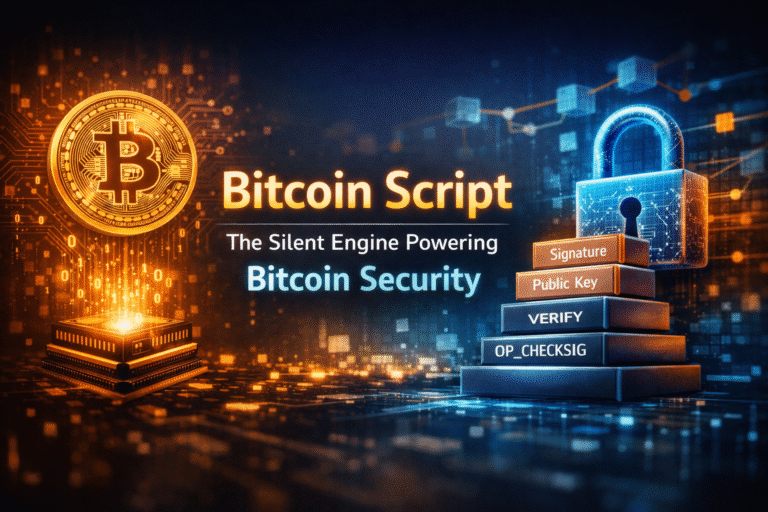
Bitcoin Script enforces transaction rules, secures ownership, and enables decentralized verification, forming the technical backbone of the global Bitcoin network.
Bitcoin Script operates silently behind every Bitcoin transaction, ensuring security, validity, and decentralization across the network. Moreover, it eliminates middlemen and replaces them with rules enforceable in code Therefore, the users have trust in Bitcoin without the need of the central authorities. For this reason, an understanding of Script explains how Bitcoin achieves trustless value transfer.
Bitcoin Script Defines the Rules of Bitcoin Transactions
Bitcoin Script is a light-weight stack-based programming language which is embedded into Bitcoin transactions. Importantly, it gives some conditions before Bitcoin can be considered spendable. For instance, scripts may require valid signatures or time constraints or may require multiple approvals. As a result, Bitcoin transactions are carried out according to predetermined and transparent rules.
Bitcoin has been around since 2009 with Script from the get-go. Since then, more than 900000000 transactions have been performed using Script validation. Therefore, Script has proven to be reliable at global scale. Moreover, by having a limited design, its attack surfaces are reduced significantly.
Bitcoin does not keep any accounts like banks or exchanges. Instead, it tracks UTXOs, which stands for unspent transaction outputs. Each UTXO contains Script conditions for what will need to be spent in the future. Consequently, Bitcoin has better transparency and auditability.
Locking Scripts Establish Spending Conditions
Each transaction output has a locking script that determines who can spend the Bitcoin. Typically, it requires the proof of the ownership of the private key. Therefore, fund unlocking is only accessible to authorized users. This mechanism is a cryptographic mechanism used to protect ownership.
Most common transactions are Pay to Public Key Hash scripts. These scripts lock-in +99% of Bitcoin outputs from the past. As a result, Script has secured trillions in value. This extensive use is evidence of the reliability of Script.
Unlocking Scripts Prove Ownership
When spending Bitcoins, wallets will create unlocking scripts automatically. These scripts comprise digital signatures and public keys. Nodes compare them to locking scripts. Expenditure If the expenditure is valid, the spending proceeds successfully.
Digital signatures employ ECDSA security with 256-bit security. This level is similar to the modern banking standards. Consequently, transactions on Bitcoin are computationally infeasible to manipulate. Script for enforcing this verification process is in place consistently.
UTXO Model Enhances Network Integrity
Bitcoin’s UTXO model is different from account-based systems, such as Ethereum. Each UTXO has to be spent completely or divided into new outputs. Therefore, double spending can easily be detected. These constraints are enforced strictly by script.
Currently, the Bitcoin network has more than 80000000 UTXOs tracked. Each has Script conditions verified during spending. This scale represents Script efficiency. In addition, it guarantees predictable validation of transactions.
Simplicity Improves Security and Performance
Bitcoin Script intentionally eschews loops, recursion and complicated functions. This helps in avoiding the risks of infinite execution. Therefore, the speed of transaction validation is still fast and deterministic.
Blocks are restricted to 4MB weight. Script simplicity makes nodes validate blocks efficiently. As a result, decentralization is still available for the average hardware user.
How Bitcoin Nodes Execute and Verify Script
Each node of the Bitcoin network independently checks for Script conditions for every transaction. Nodes run the Script of a transaction locally when broadcasting it. If conditions do not work, nodes reject the transaction instantly. Therefore, consensus arises without coordination.
Bitcoin is operated with more than 15000 nodes that can be reached worldwide. Validation of Script is done autonomously at each node. Consequently, there is no central power to control the transaction approval.
Protection of Receiver Side Script
When bitcoin is accepted, it is a UTXO stored on the blockchain. This UTXO comes with a locking script that requires cryptographic proof. Usually it requires a valid signature. Therefore, the ownership is still mathematically enforced.
Bitcoin addresses abstract Script complexity to the user. Wallets create addresses for underlying Script templates. As a result, usability is increased while security is maintained.
Spender Side Script Execution
To spend Bitcoin, automatic unlocking scripts are created by wallets. These scripts include signatures that are based on private keys. Nodes compare them to locking scripts. If matched, then the transaction is valid.
Signature verification takes place thousands of times per block. On the busiest usage, blocks can contain more than 3000 transactions. Script is efficient in handling this load. Therefore, network throughput does not change.
Independent Verification Ensures Decentralization
Each node independently performs transaction verification without trusting anyone else. Even one invalid result of a Script results in rejection. Therefore, attackers have to fool the majority of nodes at the same time.
Bitcoin has recorded uptime of greater than 99.98% since it launched. Script-based verification helps make this resilience. For that reason, Bitcoin is operational under extreme conditions.
Mempool and Script Validation
Before they are confirmed, transactions go into the mempool. Nodes Check Script before Mempool Acceptance Invalid transactions are immediately discarded. This filtering helps to reduce network spam.
During congestion, the size of mempools can be > 300000 transactions. Script validation is used to make sure that only valid transactions remain. As such, network reliability is increased.
Real World Applications Enabled by Bitcoin Script
Bitcoin Script has made it possible to create more complex transaction types than just simple payments. These include multi-signature wallets, time-locks, escrow arrangements and payment channels. Therefore, Script adds a lot of functionality to Bitcoin.
Multi-Signature Security of Wallets
Multi-signature wallets require more than one approval to spend money. For example, the 2-of-3 wallet requires 2 valid signatures. This setup reduces single point failures.
Over 20% of institutional Bitcoin holdings are stored in multi-signature. Exchanges and custodians use this feature of Script. For that reason, security of assets is improved.
Time-Locked Transactions
Time-locks allow no spending until some future block height or timestamp. These scripts provide for delayed payments and recovery procedures. Therefore, more control is provided to the users.
Time-locks are very crucial for the Lightning Network. Millions of microtransactions occur off-chain in lightning. Script imposes security on channel in the process of settling
Escrow and Conditional Payments
Escrow transactions are used to hold Bitcoin until specified conditions are met. Script forces these conditions without intermediaries. Therefore, there are fewer trust requirements.
Escrow is usually deployed in peer-to-peer trading platforms. Script guarantees fair execution. This helps in the support of the global commerce without any centralised oversight.
Exchanges and Payment Processors
Major exchanges such as Coinbase, Binance, and Kraken use Script for deposit and withdrawal. Payment processors such as BitPay also utilize Script a lot. Therefore, Script serves as the foundation for the financial infrastructure on Bitcoin.
Daily exchange settlement volumes are over 200000 BTC in active periods. Script is used to validate each transaction. This is a scale that shows the robustness of Script.
Blockchain Explorers and Analytics
Blockchain explorers parse the data in Scripts to interpret transactions. Platforms such as Blockchair analyze types of Scripts and usage. Therefore, the transparency is enhanced for researchers.
Script data is used to help identify trends in the network and security problems. Analysts depend on Script visibility. As a result, monitoring of the ecosystem is enhanced.
Bitcoin Script and Network Security Model
Bitcoin Script has no discretion or bias in administering rules. The validation logic is identical on all nodes globally. Therefore, censorship resistance is still strong.
Script helps to prevent unauthorized spending and double spending. In combination with proof-of-work, it makes the ledger secure. The market capitalization of the Bitcoin has been over 1000000000000 at the height of cycles. Script protects this value.
Design Tradeoffs and Limitations
Bitcoin Script has no expressiveness in comparison with smart contract platforms. However, this is to decrease bugs and exploits. Therefore, Bitcoin is more interested in stability.
Ethereum had multiple contract exploits with a loss of greater than 3000000000 in the past. Bitcoin does not suffer from such risks because of Script simplicity. This is a conservative design, adding to trust.
Script as Bitcoin’s Governance Mechanism
Bitcoin rules are carried out thanks to Script and consensus. Changes must be agreed upon network-wide. Therefore, governance is decentralised.
Script updates are done by soft fork such as SegWit and Taproot. These upgrades increase efficiency without compromising compatibility. As such, Bitcoin is an evolving coin, albeit cautiously.
Why Bitcoin Script Matters for the Future
Bitcoin Script may seem technical, but this is the core security model of Bitcoin. Wallets conceal complexity, but Script ensures fairness. Therefore, users are benefited without understanding internals.
Learning Script helps the user appreciate programmable money principles. Bitcoin is not only a ledger but actually a rule based system. Script allows for decentralization at scale.
As more is adopted, the value of Script will continue to grow to trillions. Its positive track record since 2009 fosters trust. In the end, the Bitcoin Script is the silent driver of the global digital trust engine.
Conclusion
Bitcoin Script is still the silent force behind protecting each and every bitcoin transaction in the world. It replaces trust with transparent rules that are applied equally to all nodes. Therefore, Bitcoin is able to deliver security, decentralization and reliability without a central control. Understanding Script explains why Bitcoin is still operating at global scale securely.