
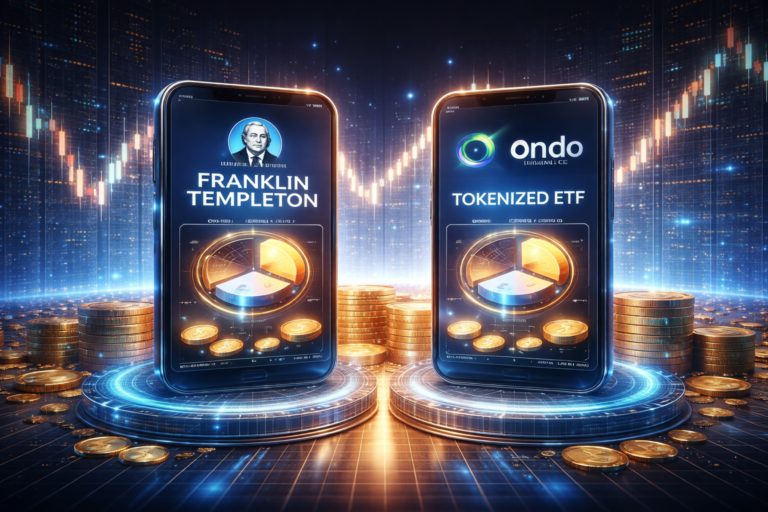
Franklin Templeton and Ondo launch tokenized ETFs for 24/7 trading via crypto wallets, bringing stocks, bonds, and gold investments onto blockchain networks worldwide.
Franklin Templeton announced a partnership with Ondo Finance to launch tokenized ETFs on blockchain networks. These new products can trade around the clock, 7 days a week using crypto wallets instead of brokerage accounts. The launching is yet another step in bringing traditional finance onto digital systems.
New Tokenized ETFs Allow 24/7 Trading Without Brokers
According to Bloomberg, the new products let investors exchange-traded funds at any time. Normally, ETFs trade during stock market hours only. However, trading can take place day and night with blockchain technology. Due to this change, investors are able to respond more quickly to news in the marketplace.
Franklin Templeton is partnering with Ondo Finance to offer tokenized versions of its ETFs that trade around the clock through crypto wallets, bypassing the brokerage accounts and limited trading hours that have defined fund investing for decades https://t.co/Q2DxrT559B
— Bloomberg (@business) March 25, 2026
Ondo Finance supplies tokenization system for the project. The company purchases actual ETF stock shares and puts them in a special-purpose vehicle. After that, digital tokens are created to represent the value of those shares. These tokens offer the same return rights to holders as the original funds.
Related Reading: What Is Asset Tokenization on Blockchain? Fundamentals and How It Works – Ledger Tribune
Five funds are part of the first launch of the platform. The FFOG fund is focused on growth stocks within the United States market. The FLQL fund is based on a large company equity strategy. The FGDL fund is tracking the price of gold. The FLHY fund invests in high yield corporate bonds. The INCE fund is focused on income based U.S equities.
While the tokens are backed by real money, the investors still receive ordinary returns. However, the tokens can move faster on blockchains networks. This makes trading easier for people using digital wallet. In addition, users do not need a traditional brokerage account.
First outside the United States, the products are available. The system is available to investors in Europe, Asia-Pacific, the Middle East and Latin America. Availability in the United States is awaiting regulatory approval. Officials want to have clear rules in place before they would allow on-chain ETF trading.
Tokens Can Be Used in DeFi and Lending Markets
One important feature of tokenized ETFs is composability. This means the tokens have the ability to work inside decentralized finance systems. Investors can use tokens as collateral for loans or margin trading. Because of this feature, the products are capable of connecting with many blockchain services.
DeFi platforms are peer-to-peer platforms that enable users to lend, borrow, and trade without the involvement of banks. When ETFs become tokens, they can enter these systems quite easily. This opens up more possibilities for use of traditional investments. As a result, many companies are considering tokenization the future of finance.
Franklin Templeton is one of the world’s largest asset managers. The company oversees some $1.7 trillion in assets. It has already worked on blockchain projects in the past. Its Benji platform was one of the first on chain money market funds. Therefore, the new ETF project is continuing its digital approach.
Ondo Finance is also a business giant in tokenize asset. The firm manages some $2.7 billion in real-world asset tokens. These tokens represent things like bonds, funds and other investments. Because of the experience it has, Ondo was selected as the technology partner.
Large financial firms are currently exploring tokenization, as a way to reach more investors. Blockchain systems can reduce costs and increase the speed of settlement. They can also permit smaller investments with fractional ownership. Because of these advantages, the interest in tokenized funds continues to rise.
Tokenization Shows How Traditional Finance Is Moving On-Chain
Many banks, and asset managers believe that tokenization will change markets. Instead of paper records, ownership can exist on digital ledgers. This makes the tracking and transfer of assets easier. It also decreases the requirement for middle companies in trades.
However, regulators are continuing to understand how to regulate these new systems. Governments are interested in safeguarding investors on one hand and innovation on the other. For this reason, certain products are introduced first outside the US. Companies typically wait for clear rules before expanding.
The partnership between Franklin Templeton and Ondo is a good sign of institutional interest. Big firms are no longer ignoring the blockchain technology. Instead, they’re making actual products with it. This change may bring traditional markets closer to crypto systems.
If the tokenized ETFs are popular, more funds can move on-chain. Investors could trade stocks and bonds, as well as gold, from digital wallets. In the future, markets may be open all of the time. For now, the new launch indicates that tokenization is taking a place in global finance.

Bilal Hassan is a seasoned crypto journalist with over five years of experience covering blockchain, digital assets, and global fintech trends. His work focuses on market developments, regulatory shifts, and the evolving landscape of cryptocurrency adoption worldwide.