
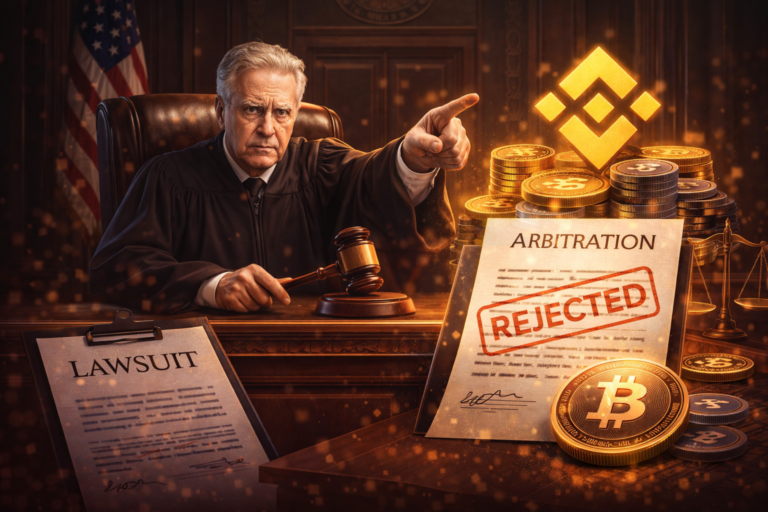
U.S. judge rejects Binance arbitration request in token lawsuit. Case over unregistered tokens will continue in federal court.
A federal judge in the United States has rejected an important request from Binance. The exchange wanted a lawsuit to head to private arbitration rather than federal court. However, the court held that the company failed to adequately inform users of changes in the terms of service of the service.
U.S. Court Blocks Binance Arbitration Request in Token Lawsuit
The ruling was made by Andrew L. Carter Jr. at the U.S. District Court for the Southern District of New York. The ruling was issued on late February 2026. It focuses on how exchange altered its user agreement in 2019.
According to the ruling, Binance introduced an obligatory arbitration clause from February 2019. The change also included a class action waiver to users. However, the judge said the company did not clearly inform users of this major change.
Arbitration is a private process in which disputes are conducted outside of public courts. More companies like arbitration because it has the potential to curb lawsuits and class actions. However, courts require clear prior notice before such rules are valid.
Judge Carter said Binance only posted updated terms on the company’s website. The company also used general pop-ups on the platform. However, the judge ruled that these actions did not go far enough to appropriately warn users.
Because of this, the arbitration clause cannot be applied to some customers. In particular, this does not apply to users who joined before February 20, 2019. Therefore, those users can proceed to federal court with their claims.
Lawsuit Over unregistered Tokens To Continue in Court
The lawsuit is known as the Williams v. Binance. It alleges that Binance sold a number of digital tokens to US investors. According to the complaint, those tokens qualified as unregistered securities under US law.
The case refers to seven specific digital assets. These are tokens of EOS, TRON, ICON, OmiseGO, aelf, FunFair, and Quantstamp. Plaintiffs say these assets should have been registered with regulators.
The plaintiff has also included Changpeng Zhao as a defendant in the lawsuit. Zhao was the previous chief executive of Binance. Plaintiffs claim that the company and its leadership were both responsible for the token sales.
This legal dispute has a long history. The case was first thrown out by a court in 2022. At that time, the judge ruled that the claims were brought too late.
However, the case has been back in the court in 2024 after a federal appeals court decision. The appeals court reinvigorated the claims, and returned the case to Judge Carter. Therefore, the lawsuit continued on in the New York federal court.
Early Binance Investor Claims Revived in U.S. Federal Court Case
The recent ruling now lets a portion of the lawsuit proceed once again. Claims related to activity prior to February 20, 2019 will continue to be in federal court. However, later claims have already been dismissed by the plaintiffs.
Binance reacted to the ruling with a public statement. The company said it will continue to strongly defend itself. It also said that many of the claims made later were voluntarily withdrawn by the plaintiffs.
Meanwhile, the ruling signals the increasing legal pressure on crypto exchanges. Governments and courts are growing concerned about how digital assets are being sold to investors. This includes questions along the lines of securities laws and consumer protections.
The case may also have an impact on how crypto companies revise their user agreements. Courts often demand that companies clearly and directly notify of important policy changes. Otherwise, those changes may not be legally enforceable.
For the time being, the Binance lawsuit is still active in federal court. Future hearings will decide whether the token sales violated any U.S. securities laws. The outcome may have an impact on how crypto platforms work in the United States.

Bilal Hassan is a seasoned crypto journalist with over five years of experience covering blockchain, digital assets, and global fintech trends. His work focuses on market developments, regulatory shifts, and the evolving landscape of cryptocurrency adoption worldwide.