

Blockchain Association releases crypto Tax Principles, proposing de minimis exemption, staking tax clarity, stablecoin treatment, and practical reporting reforms for Congress.
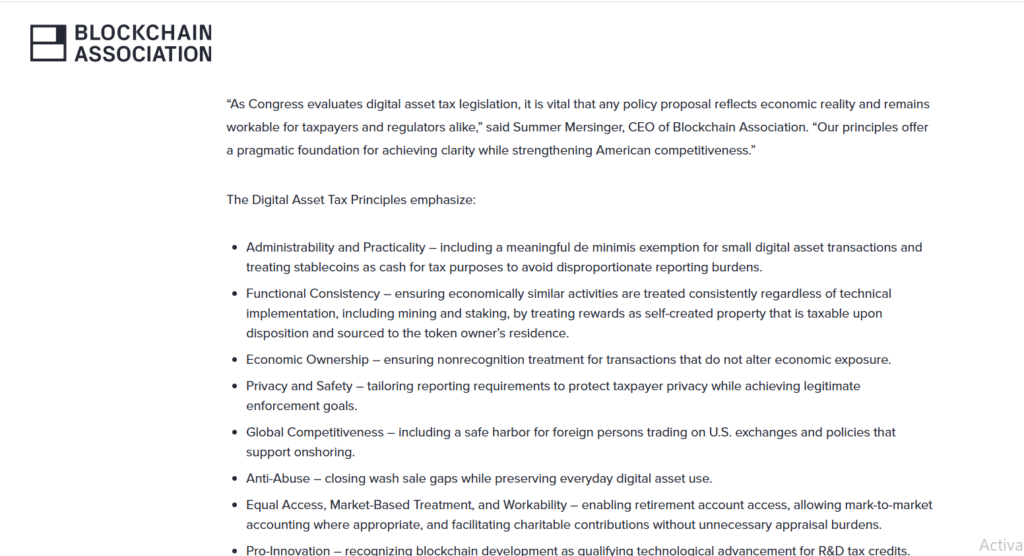
The Blockchain Association has released a comprehensive crypto tax policy framework for Congress. The guidance is aimed at more obvious and practical digital asset taxation rules. Consequently, the proposal comes as industry meetings get under way with House tax writers.
Digital Asset Tax Principles Aim to Modernize US Tax Rules
The Blockchain Association represents major United States digital asset companies and infrastructural companies. Furthermore, members include Ripple, Coinbase and Kraken. Therefore, the framework is the result of consensus input from more than 100 member companies.
1/ Today, we released our Digital Asset Tax Principles – a consensus framework built with our members and designed to inform congressional efforts to modernize tax policy for digital assets.https://t.co/OS2pBVYWCI pic.twitter.com/1tC3ZOCEa3
— Blockchain Association (@BlockchainAssn) February 24, 2026
According to the association, the policy contains 14 principles based on accepted tax concepts. Moreover, the document pays special attention to the aspects of administrability, fairness and alignment with economic reality. As such, lawmakers get structured recommendations on how to update digital asset tax legislation.
One of the central proposals is to introduce a de minimis exemption for small transactions. Furthermore, the measure would avoid tax on low-value everyday crypto purchases. Therefore, billions of minor reporting obligations could be removed under revised thresholds.
In addition, the framework suggests that staking and mining rewards should be taxed only when sold. Moreover, rewards would be owned as one’s own property until disposition occurs. As a result, the taxpayers do not get taxed instantly when they receive the money.
Stablecoin Treatment and Reporting Reforms Take Priority
The guidance recommends that stablecoins should be treated in the same way as cash for tax purposes. Furthermore, it proposes to exclude stablecoins from the definition of digital assets to be reported under Form 1099-DA. Therefore, the compliance complexity for the merchants and the users could be reduced substantially.’
Privacy considerations are also prominently featured in the proposed framework structure. Moreover, reporting obligations would not apply where there is no asset control by custodial intermediaries. Consequently, non-custodial and open source contributors would fall outside reporting mandates.
The Blockchain Association addressed global competitiveness in its policy recommendations. Furthermore, it proposed a statute granting a safe harbor to foreign persons trading on United States exchanges. Therefore, digital asset markets may decline incentives for offshore migration.
Anti-abuse measures were addressed in tandem with tax reforms with fairness concerns. Moreover, the association lent its support to capping out wash sale gaps without damaging regular transactions. Consequently, the day-to-day use of digital assets would be covered by balanced legislation.
Economic rules of ownership were another pillar of the policy of taxation. Furthermore, transfers from wallet to wallet under the common control of the same user would not be recognition events. Therefore, taxation would take place on substance and not on technical transaction structure.
Framework Targets Practical Crypto Tax Compliance
Equal access and innovation incentives also came on the released document. Moreover, the framework supported clarification of staking rewards eligibility of investment income classification. As a result, digital assets may fit better into retirement structures.
The availability of mark-to-market accounting treatment was also recommended by the association. Furthermore, this approach could make it easier to report from spot and derivatives holdings. Therefore taxpayers benefit from flexibility in line with other actively traded financial assets.
Charitable giving provisions were incorporated among workability-oriented policy suggestions. Moreover, unneeded third party appraisal requirements could be lowered for transparent markets. As a result, digital asset donations may prove more appealing to taxpayers.
Summer Mersinger previously gave testimony before the House Ways and Means Committee on crypto tax modernization needs. In addition, the association confirmed meetings with close to 24 congressional offices today. Therefore, the involvement of industry with lawmakers is continuing to expand as tax policy debates continue to proceed.

Bilal Hassan is a seasoned crypto journalist with over five years of experience covering blockchain, digital assets, and global fintech trends. His work focuses on market developments, regulatory shifts, and the evolving landscape of cryptocurrency adoption worldwide.