
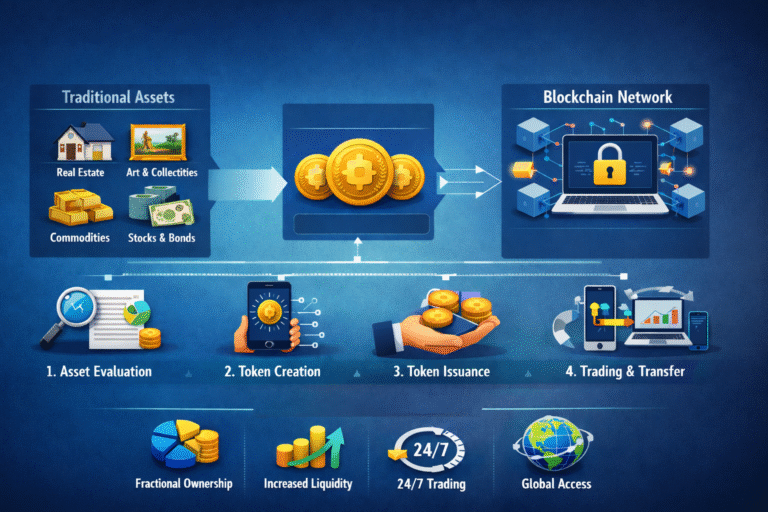
Asset tokenization on blockchain turns real-world assets into secure digital tokens in 2026, enabling faster transactions, and global access.
Asset tokenization is revolutionizing finance by turning real-world assets into secure, tradable digital tokens. These tokens provide for faster transactions, lower costs and instant global access for investors. Blockchain makes ownership transparent and tamper-proof while fractionalization makes high-value assets accessible to everybody.
Blockchain Tokenization Explained Simply
Tokenization in blockchain is the process of converting sensitive asset into secure digital asset called token. First, original data remains safe while tokens help to safely execute daily operations. Moreover, blockchain tokens pass value and information only efficiently. These programmable units enhance liquidity, transactions speed up and transparency is enhanced. Therefore, tokenization is a boon to finance, data security and wider digital ecosystems in the world today and globally.
Digital Ownership on Distributed Ledgers
Digital ownership on distributed ledgers means that control shifts from access based licenses to verifiable asset based digital ownership models. Moreover, assets get tokenized in the form of digital tokens that are secured on the decentralized blockchain ledgers.
Once consensus is made and validated, the records cannot be changed and collaborate ownership permanent. Additionally, smart contracts automate transfers, eliminate intermediaries, increase transparency, improve security, and increase access throughout modern financial markets.
Why Tokens Cannot Be Duplicated or Altered
Tokens are difficult to duplicate/substitute since systems have control over making them unique, encryption, and a set of stringent rules to maintain data integrity. For example, Bitcoin has more than 1,000,000 nodes that are secured by hash-linked blocks. Similarly, Ethereum has a huge number of smart contracts processed more than 1,000,000 per day.
In Cybersecurity, JWT token uses 256-bit cryptographic signatures with strict expiry timestamp. Therefore, copied visuals can never copy authority, value or control across blockchain, security or gaming systems.
Types of Blockchain-Based Tokens
Blockchain-based tokens are of two types – fungible and non-fungible – which fulfil different economic and technical purposes. Fungible tokens are still open to interchanging, like in fiat currencies, to enable payment, governance, stability & platform utility. In 2024, stablecoins such as USDT and USDC measured upward of $10T in transactions on the world’s blockchain.
Fungible types include utility tokens such as BAT, governance tokens such as UNI and payment tokens such as BTC. Meanwhile, NFTs are unique and irreplaceable that helps in powering the digital art, gaming assets and also tokenize real-world items. NFT Markets Trading volumes across this period (2023 in general) this segment of the market recorded $24B+, highlighting the overall adoption from different sectors.
Digital Instruments Back by the Valuable
Value-backed digital instruments are blockchain tokens that are linked to assets such as USDT, USDC, gold, tokenized bonds, and CBDC. In 2025, There were more than $10 trillion processed by stablecoins that reflect their safer alternatives to volatile cryptocurrencies and bridge traditional finance and DeFi.
These instruments provide for stability, efficiency, and transparency. Fractional real estate or art ownership increases accessibility and tools such as Cryptio for the verification of reserves. Some of the risks are the reliability of reserves, counterparty dependency, and lack of clarity of regulations under EU MiCA. Global adoption is expected to reach over $350 billion in 2026.
Access-Oriented Network Units
Access-oriented network units are blockchain tokens that gate entry to a network, service, or decentralized app (dApp). Filecoin (FIL) and Basic Attention Token (BAT) are the clearest examples: holders spend or stake the token to unlock storage space or an ad-free browsing experience.
Filecoin’s storage network kept growing through 2025. New daily storage deals rose 25% quarter-over-quarter by Q2, and the network shifted from high-volume, low-value deals toward fewer, larger enterprise contracts, according to Messari’s State of Filecoin reports. That shift signals real institutional demand for decentralized alternatives to cloud storage, not just speculative trading.
These tokens do more than gate access. Smart contracts use them to automate participation, and some networks route them through peer-to-peer energy trading, letting users buy and sell power directly instead of going through a utility.
Native Blockchain Exchange Assets
Native blockchain exchange assets are tokens that crypto exchanges issue to fund their own ecosystems, deepen liquidity, and reward users. BNB, Cronos (CRO), and Uniswap (UNI) are the best-known examples. Each carries real weight on its platform: high market caps, heavy trading volume, and — in Uniswap’s case — a direct vote in how the protocol is governed.
Mechanism of Creating and the Lifecycle of Tokens
Every token starts with a smart contract that defines its purpose, name, and supply — fixed or inflationary. Once launched, it enters circulation: people trade it, stake it, or spend it on network fees.
A token’s life can end deliberately, too. Issuers burn tokens (permanently destroying them) or build in an expiration date to manage supply. Security audits and regulatory compliance checks run throughout the token’s life, keeping it safe to use and lawful to sell.
Flow for Smart Contract Deployment
Smart contracts are self-executing code that runs on a blockchain and can’t be altered once deployed. Developers typically write them in Solidity for Ethereum or Rust for Solana, then compile the code into bytecode plus an ABI (application binary interface) that other apps use to interact with it.
Deployment cost depends heavily on the network. Ethereum gas fees can run $200–$400 per deployment, while Polygon and Solana charge closer to a few cents. Contracts usually launch first on a testnet, such as Ethereum’s Sepolia, before going live at a permanent address.
This isn’t just theory. Walmart’s blockchain pilot with IBM cut the time to trace a mango back to its farm from seven days to 2.2 seconds — proof smart contracts can solve real supply-chain problems, not only crypto-native ones (Linux Foundation Decentralized Trust case study).
Verification, Issuance, and Circulation
Turning a real-world asset into a blockchain token — tokenization — happens in three stages: verification, issuance, and circulation.
Verification confirms who owns the asset, what it’s worth, and that reserves match the claim. A $10 million building, for example, might be appraised and audited before a custodian issues 100,000 tokens against it. Legal checks — property titles, SEC or MiCA rules — happen before a single token is issued.
Issuance means minting the tokens, often on Ethereum or Solana, structured through a special purpose vehicle (SPV) that legally holds the underlying asset. After passing KYC/AML checks, investors can buy fractional stakes for as little as $100.
Circulation is where tokens change hands. Exchanges like Uniswap or Coinbase list them, and smart contracts automate payouts such as dividends.
Real-World Applications of Tokenized Assets
Tokenization turns physical or financial assets into digital tokens that trade with verifiable proof of ownership. By late 2025, the on-chain real-world asset (RWA) market — not counting stablecoins — had passed $35 billion, up roughly 130% for the year, with private credit and U.S. Treasuries leading adoption, according to data from RWA.xyz.
Financial products are moving fastest. Tokenized Treasuries and corporate bonds can now settle in seconds instead of days. Real estate platforms like RealT let investors buy property shares for as little as $50. Tether Gold (XAUT) lets holders trade physical gold around the clock. Art, microfinance, and carbon credits are following the same path, gaining liquidity they never had as paper assets.
Currency-Pegged Digital Units
Stablecoins are cryptocurrencies pegged to a fiat currency, usually the US dollar, to hold a steady value. By late 2025, the market had grown to about $306 billion, with monthly transaction volume topping $1 trillion for the first time, according to DeFiLlama data.
Fiat-backed stablecoins like USDT and USDC dominate the market, holding most of their reserves in cash and short-term Treasuries. Crypto-backed stablecoins like DAI take a different approach: they over-collateralize with other crypto assets and enforce the peg through smart contracts.
Algorithmic stablecoins skip collateral entirely and let code manage supply — a design that failed badly in 2022, when TerraUSD’s collapse wiped out roughly $40 billion in value. Tether and USDC still lead on trust and liquidity, especially for cross-border payments.
Property Fractionalization Models
Real estate fractionalization splits ownership or income from a property into digital tokens, letting many investors hold a slice of an asset that used to require a six- or seven-figure check. Platforms like RealT and Lofty AI have pushed minimum investments down to around $100.
A few models dominate: direct equity tokenization, where tokens represent literal shares in the entity holding the property; SPV-based tokenization; tokenized cash-flow rights, which pay income without conferring ownership; and debt- or basket-based tokenization that spreads risk across several properties.
Smart contracts automate the busywork — dividends, minimum holding periods, maintenance schedules — while oracles feed in real-world data like appraisals to keep records accurate. Market-size forecasts for 2030 vary widely by source; treat any single number here as a directional estimate rather than a fixed target.
Debt Instruments on Blockchain
Tokenized debt puts bonds, loans, and commercial paper on-chain, cutting settlement time and letting investors buy in fractionally. Platforms like HSBC Orion and Ondo Finance are pushing settlement toward T+0 — same-day — and cutting costs versus traditional processing.
Major issuers include BlackRock’s BUIDL fund, the World Bank, the European Investment Bank, and J.P. Morgan’s commercial paper desk. Minimum ticket sizes as low as $100 open a market that once required institutional-size capital.
Art, Media, and Intellectual Rights
Tokenizing art, media, and intellectual property turns ownership stakes into tradable digital tokens, so a multimillion-dollar painting can be divided into thousands of shares. Smart contracts handle royalty payouts automatically and let assets trade around the clock instead of through occasional auctions.
A few real examples illustrate the trend: Swiss custodian Sygnum split a Picasso into thousands of tokenized shares, musician Nas sold song royalties through the platform Royal, and IBM’s IPwe has moved large patent portfolios onto NFTs. Tokenization has also helped fund independent films and given fans fractional access to sports and entertainment rights.
Gaming Economies and Virtual Items
In gaming, tokenization means turning in-game items into NFTs that players actually own and can resell, instead of losing everything if a game shuts down. Marketplaces like OpenSea let players cash out assets at real-world prices.
Axie Infinity, The Sandbox, Decentraland, and Gods Unchained popularized the model, pairing play-to-earn rewards with, on some platforms, the ability to move assets between games. Analysts broadly expect blockchain gaming to keep growing through 2030, though size projections vary a lot by source — worth a fresh check before quoting a specific number.
Benefits Driving Token-Based Markets
Token-based markets point to a structural shift in global finance. Tokenized real-world assets were worth roughly $18–35 billion by late 2025 depending on the tracker used, and most forecasters expect the multi-trillion-dollar range by 2030. That range is wide because methodologies differ — some trackers count stablecoins and private credit, others don’t — so it’s worth citing the source alongside any figure.
Increased Speed of Settlement Infrastructure
Tokenization enables faster settlement worldwide. Atomic settlement lets an asset and its payment change hands at the same instant, shrinking settlement windows from T+2 (two business days) to minutes. That frees up capital sooner, improving liquidity management for institutions.
Improved Market Depth
Tokenization deepens markets by fractionalizing illiquid assets into smaller units. A $100 million property, for instance, could be divided into a million tokens. Round-the-clock trading adds constant price discovery and makes it easier for smaller investors to participate.
Operational Cost Efficiency
Smart contracts automate dividends, interest calculations, and coupon payments, cutting the manual work and processing delays that come with traditional settlement. Removing brokers and clearinghouses from the chain also reduces reconciliation work, which is where most of the cost savings show up.
Investor Accessibility Expansion
Lower minimums open elite asset classes to more investors. Private equity minimums, for example, have fallen from the millions to closer to a few hundred dollars on some tokenized platforms. Because blockchain networks are borderless, issuers also reach investors who’d otherwise be blocked by cross-border settlement rules.
Audit-Friendly Transparency
Immutable ledgers record every transaction, creating a single, tamper-proof source of ownership history. Compliance rules like AML and KYC can be built directly into a token’s logic, which makes real-time auditing far more accurate than periodic manual review.
Risks and Barriers Facing Token Adoption
Adoption still faces real friction. Security losses hit record levels in 2025, compliance penalties climbed into the hundreds of millions, and legal frameworks remain fragmented across borders — a combination that slows both institutional and retail adoption.
Regulatory Fragmentation Challenges
Regulatory fragmentation remains a top concern for token markets. Frameworks like the EU’s MiCA and the US GENIUS Act have brought some clarity, but alignment across jurisdictions is still limited, and several exchanges have had to pause operations in specific markets over regulatory uncertainty.
Infrastructure Vulnerabilities
2025 was the worst year on record for crypto theft. Hackers stole more than $2.1 billion in the first half of the year alone, and the full-year total reached roughly $3.4 billion. The February breach of exchange Bybit accounted for about $1.5 billion of that on its own — nearly 70% of all funds stolen from crypto services in 2025, and the largest single crypto theft on record.
Compliance and Reporting Burdens
Compliance costs have climbed sharply for exchanges, driven by AML and KYC systems, transaction monitoring, and reporting infrastructure. Enforcement has kept pace: regulators worldwide issued larger fines through 2025, and U.S. authorities alone brought well over a billion dollars in cumulative penalties tied to digital-asset violations.
Tokenization in Private and Institutional Markets
Tokenization is reshaping private and institutional markets by giving ownership a digital, tradable form. The tokenized asset market — including stablecoins — has grown from a few billion dollars in 2019 to well over $300 billion by late 2025, with stablecoins driving most of that growth.
Cross-Border Trading Enablement
Tokenization lets assets trade across borders quickly and cheaply. Because tokens run on networks that never close, investors anywhere can access them 24/7. Stablecoins in particular move faster and cheaper than traditional bank rails, which helps cut the fraud and reconciliation costs that add up in cross-border payments.
Clearing and Settlement Optimization
Tokenization compresses settlement from days to minutes or seconds. Smart contracts automate payments like dividends and interest, and a single immutable ledger removes the duplicate record-keeping that slows traditional clearing.
Institutional Custody Integration
Tokenized assets need custody providers built for the job — ones that plug into existing reporting and risk systems. Institutional interest in crypto custody has grown steadily since 2020, and providers now typically use audited, segregated accounts to safeguard tokenized holdings.
Public Versus Permissioned Token Networks
Corporate users increasingly favor hybrid setups that mix public and permissioned token networks, balancing speed, privacy, and regulatory compliance. Public blockchains still hold the larger share of overall activity, but permissioned networks — which verify participant identity rather than allowing pseudonymous access — are growing faster and can process far higher transaction volumes.
Enterprise-Controlled Ledger Use
A growing share of Fortune 100 companies now run hybrid or fully permissioned blockchain networks for critical workloads. Banking and financial services lead adoption — JPMorgan’s Onyx platform, for instance, handles real-time settlement for institutional clients.
Transfer Rules and Access Controls
Permissioned ledgers enforce strict governance. Administrators assign roles like validator or read-only access, and attribute-based encryption limits who can see what data. Smart contracts enforce these rules automatically, while privacy tools like zero-knowledge proofs and fully homomorphic encryption let institutions analyze data without exposing it.
Strategic Impact on Investment Models
Asset tokenization is reshaping how institutions build portfolios. Major players — BlackRock and JPMorgan among them — have moved from pilot programs to production-scale deployment, a signal that tokenization is no longer an experiment for large finance.
Efficiency and Cost Reduction
Blockchain and smart contracts cut operating costs across financial markets. Transaction costs can fall sharply, real estate transactions can close faster than through traditional title and escrow processes, and settlement that once took one to two business days can now happen in minutes.
Portfolio Construction and Liquidity
Fractional ownership brings minimum investments down to $50–$100 on many platforms, opening markets once reserved for wealthy individuals and institutions. Round-the-clock secondary trading adds liquidity that traditional private markets never had. Through 2025, private credit and U.S. Treasuries made up the bulk of tokenized RWA activity, with tokenized Treasuries seeing especially rapid growth.
Forward Outlook for Blockchain-Based Assets
Blockchain-based assets are still in early growth. Forecasts for the tokenized RWA market by 2030 range from the low trillions to well into the tens of trillions, depending on the source and what’s counted. Institutions are treating digital assets as core infrastructure rather than a side experiment, which should keep driving efficiency and cost savings across markets.
Regulatory Maturity Expectations
Regulatory clarity tends to speed up institutional adoption. The EU’s MiCA framework and the US GENIUS Act have moved stablecoin rules forward, and many jurisdictions introduced new crypto-specific rules through 2025. Even so, most industry leaders still name regulatory uncertainty as a top adoption hurdle.
Financial Infrastructure Transformation
Digital assets are becoming core financial infrastructure rather than a niche product. BlackRock’s BUIDL fund and JPMorgan’s Kinexys platform both process substantial daily volume. Tokenization enables 24/7 trading, faster settlement, and — over time — real savings in middle- and back-office operations.
Frequently Asked Questions About Tokenized Systems
Why Convert Assets to Digital Form?
Tokenization shifts value from physical certificates and siloed databases to shared, programmable ledgers. It enables near-instant settlement and can meaningfully cut administrative costs. Smart contracts automate transactions like dividend payments, interest, and regulatory reporting.
Which Assets Qualify for Tokenization?
Almost anything with a defined value can be tokenized: stocks, U.S. Treasuries, private credit, corporate bonds, and mutual funds are common today. Real estate, fine art, gold, and collectibles qualify too. So do intangible rights — intellectual property, music royalties, carbon credits, and future service access.
How Does Tokenization Create Liquidity?
Tokenization makes static, illiquid assets easier to buy and sell. Fractional ownership lowers the barrier to entry — dividing a $10 million property into $1,000 units, for example. Markets run 24/7, and secondary markets let investors exit private equity or venture positions earlier than they otherwise could.
What Are the Long-Term Benefits for Investors?
Institutions use tokenization for growth and stability, not just speed. It makes custom portfolios easier to build, and transparent, on-chain ownership history helps cut down on the kind of fraud that has long plagued high-value collectibles like art and diamonds.
Conclusion
Asset tokenization is changing how finance works globally, making assets faster to trade, cheaper to access, and open to investors who were priced out before. It adds transparency, cuts down on fraud, and makes fractional ownership of high-value assets routine rather than exceptional.
With smart contracts automating processes and markets running 24/7, investors gain real flexibility. The risks — hacks, regulatory gaps, compliance costs — are just as real as the upside, and any credible account of this market has to hold both at once. Tokenization is shaping a more liquid, more borderless financial system, but it isn’t there yet.
FAQs
What is tokenization in banking?
In banking, tokenization replaces sensitive data with secure tokens to protect customer information.
What is tokenization in blockchain?
Tokenization in blockchain converts real or digital assets into tokens that can be stored and traded on a blockchain.
What is tokenization in crypto?
In crypto, tokenization represents assets or rights as digital tokens that can be transferred on blockchain networks.
What is tokenization in finance?
Tokenization in finance turns traditional assets into digital tokens, making them easier to trade and manage.
What is tokenization example?
Tokenization is converting a property into digital tokens so multiple investors can own small shares.

Bilal Hassan is a seasoned crypto journalist with over five years of experience covering blockchain, digital assets, and global fintech trends. His work focuses on market developments, regulatory shifts, and the evolving landscape of cryptocurrency adoption worldwide.