
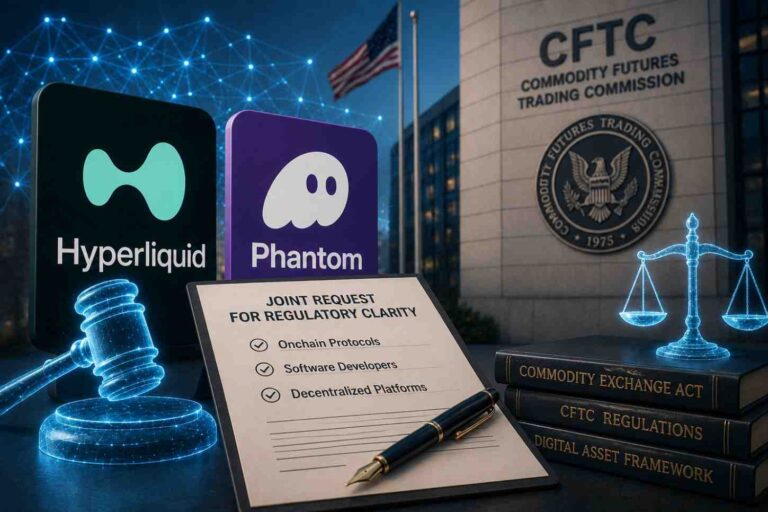
Hyperliquid Policy Center and Phantom ask the CFTC to clarify onchain software rules, protect developers, and support regulated blockchain infrastructure.
The Hyperliquid Policy Center (HPC) and Phantom have asked the U.S. Commodity Futures Trading Commission (CFTC) to update its approach to blockchain regulation. The two organizations jointly submitted a comment letter asking for more clarity around the rules for onchain market infrastructure. They think that today’s regulations can foster innovation while safeguarding users and enabling regulated digital asset markets in the United States.
What Is the Hyperliquid and Phantom Proposal to the CFTC?
The joint submission is a response to the CFTC’s request for information on onchain financial markets. Current rules were designed for traditional financial institutions, said Hyperliquid Policy Center and Phantom. But blockchain technology has brought new systems that operate differently from the older financial systems.
Hyperliquid Policy Center and Phantom Urge CFTC to Clarify That Publishing Onchain Protocol Software Does Not Require Registration
Hyperliquid Policy Center (HPC) and Phantom submitted a joint comment letter to the CFTC, urging the agency to modernize its regulatory framework… pic.twitter.com/15N5InFo6W
— Wu Blockchain (@WuBlockchain) July 9, 2026
The organizations requested the CFTC to confirm that open-source onchain protocol software does not need to be registered. They said that developers shouldn’t be considered exchanges or clearinghouses just because they write software. Rather, registration should only be available to firms that offer regulated financial services.
The letter states that blockchain developers create technology, not customer assets. Therefore, software publishing alone should not trigger financial registration requirements.
Most decentralized blockchain protocols are self-custodial, which is explained in the proposal. Users retain control of their assets rather than entrusting them to a central entity. Consequently, developers do not keep customer money or carry out transactions for customers.
Why Do Hyperliquid and Phantom Want Clear Rules for Onchain Software?
Regulatory uncertainty is a drag on blockchain innovation, Hyperliquid Policy Center and Phantom believe. Many developers are still uncertain whether they will be subject to financial regulations that are geared toward traditional businesses if they develop open source software.
So, the organizations requested the CFTC to make a clear distinction between software developers and financial intermediaries. They feel this separation would allow developers to keep developing blockchain technology without any legal uncertainty.
The letter also emphasizes transparency of blockchain. Transactions are written on public ledgers which can be verified by anyone. As a result, blockchain systems are not like many of the traditional financial systems.
The groups think that the new rules should take these differences into account. Simply, clarity would enable businesses to invest more confidently in blockchain infrastructure without fear of non-compliance with U.S. laws.
How Could New CFTC Rules Benefit Blockchain Companies and Developers?
One of the other significant requests is directed at regulated financial institutions. Hyperliquid Policy Center and Phantom requested the CFTC to develop a compliance route for licensed exchanges and clearinghouses interested in utilizing blockchain infrastructure.
In this model, regulated entities can leverage blockchain networks to manage transactions, settlements, customer fund segregation, and operations. As a result, financial institutions would be able to modernize their services without losing the regulatory oversight.
The organizations think that blockchain technology can help to enhance efficiency, cut down on operational costs, and boost transparency. So, if regulated firms are allowed to use blockchain infrastructure, it can enhance the traditional finance and digital asset markets.
The proposal also requests the CFTC to make its March no-action letter with Phantom Wallet official. The agency earlier this year announced that Phantom is not an introducing broker under certain circumstances. But the organisations feel that there should be permanent regulatory certainty for similar wallet providers.
They asked the CFTC to make this guidance into a regulation. This would mean that non-custodial wallet providers would be better protected throughout the industry rather than on a temporary basis.
What Could This Mean for the Future of Onchain Finance?
Hyperliquid Policy Center and Phantom think that more transparent regulations could facilitate Americans’ access to regulated onchain derivatives via compliant financial institutions. They also think that businesses would be more confident in developing financial services on the blockchain.
Furthermore, the organizations said updated rules would encourage responsible innovation without reducing consumer protection. They do not want to weaken oversight, but rather regulations that are more representative of the decentralized nature of blockchain technology.
The proposal also acknowledges the increasing importance of blockchain in the international financial system. Financial institutions around the world are still looking into digital assets, tokenized payments, and decentralized infrastructure. Therefore, many industry participants believe regulations should evolve alongside technological progress.
The CFTC is considering public comments in its deliberations on whether to revise its regulations. The agency has not made any final decisions, but the Hyperliquid Policy Center and Phantom submission is part of the larger debate on blockchain regulation in the United States.
In general, the proposal aims to provide more clarity in the law, not less. Hyperliquid Policy Center and Phantom aim to foster a more robust ecosystem for innovation, compliance, and sustainable growth in the U.S. digital asset sector by separating software developers from financial intermediaries and promoting the development of regulated blockchain infrastructure.

Bilal Hassan is a seasoned crypto journalist with over five years of experience covering blockchain, digital assets, and global fintech trends. His work focuses on market developments, regulatory shifts, and the evolving landscape of cryptocurrency adoption worldwide.