
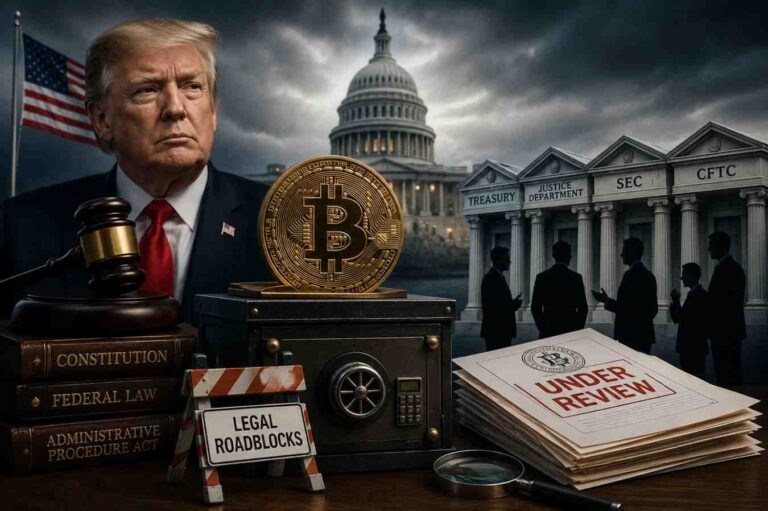
Trump’s Strategic Bitcoin Reserve plan faces legal delays as U.S. agencies debate Bitcoin custody, regulation, and management under federal law.
President Donald Trump’s plan to create a U.S. Strategic Bitcoin Reserve has hit legal and bureaucratic obstacles. According to Bloomberg, the federal agency in charge of the reserve remains to be determined. This has led to one of the administration’s largest crypto efforts coming to a standstill as government attorneys consider the legal structure.
Why Is Trump’s Strategic Bitcoin Reserve Plan Facing Legal Challenges?
Executive Order 14233 was signed by President Trump on March 6, 2025. The order instructed the federal government to halt selling the seized Bitcoins and create a Strategic Bitcoin Reserve. The reserve was originally planned to be operated by the U.S. Department of the Treasury.
The Trump administration’s plan to create a Strategic Bitcoin Reserve has been complicated by two government departments vying to run it, alongside questions about which has the legal authority to do so. https://t.co/2VzELpjexk
— Bloomberg (@business) July 6, 2026
But later on, the government officials have raised doubts about the legal powers of the Treasury to keep and control the national Bitcoin assets. So, the administration sought the advice of legal counsel before taking any further action.
Read more: FTX News: FTX Founder Sam Bankman-Fried Applies for Trump Pardon as FTT Surges 62% – Ledger Tribune
The U.S. Department of Justice’s Office of Legal Counsel is currently advising the Treasury and the Department of Commerce, Bloomberg reports. They want to establish a legal framework that meets all current federal legislation.
The Justice Department stated that its lawyers are considering all options. But officials have yet to say when the review will be finished. The Treasury and Commerce Department did not respond to requests for comment.
How Will the U.S. Strategic Bitcoin Reserve Be Managed?
The Trump administration is now mulling the idea of moving the Strategic Bitcoin Reserve from the Treasury to the Department of Commerce. But a final decision has yet to be made.
President Trump also directed both departments to find ways to get more Bitcoin without spending more money. So, any new Bitcoin transactions will have to be budget neutral and comply with federal financial regulations.
A second problem is the management of the reserve. Federal agencies are still debating who should be responsible for managing the Bitcoin, controlling the private keys, and overseeing the security of digital assets. This has resulted in a number of key deadlines already being missed without a final agreement.
The government was to finish an inventory of digital assets within 30 days. Also, Treasury was to come up with custody plans within 60 days. But both deadlines passed without any legal issues being resolved.
What Is Delaying the Launch of the U.S. Strategic Bitcoin Reserve?
Another obstacle is the Bitcoin that the U.S. government already has. The majority of these assets were the result of criminal investigations and civil forfeitures, such as significant seizures associated with the Silk Road marketplace and the Bitfinex hack.
Not all the Bitcoins that the government seizes, though, can be added to the reserve. Certain assets are required by law to be returned to the victim of a financial crime pursuant to court orders. So, the amount of Bitcoin that can be legally held for long-term government ownership remains to be decided.
Security is also a key consideration. The U.S. Marshals Service has had previous problems with digital asset custody. As a result, agencies are seeking more security before putting government Bitcoins in a national reserve.
In the meantime, the Trump administration is continuing to back digital assets as part of its financial plan. But the crypto market has also taken a hit. A Nansen report quoted by The New York Times found that almost 988,905 retail investors collectively suffered a loss of $3.81 billion when they purchased the TRUMP memecoin. Moreover, the token has dropped approximately 97% from its all-time high.
The Strategic Bitcoin Reserve is separate from the TRUMP memecoin. Both, however, have brought crypto policies under the spotlight for the administration. The supporters hope that the reserve will help to consolidate the position of the United States in the international digital asset market.
Overall, the Strategic Bitcoin Reserve is one of the most important cryptocurrency plans of the Trump administration. But legal audits, agency wrangling, security issues and custody issues keep it from going live. The reserve is likely to continue to be developed until federal officials reach a consensus on a legal structure.

Bilal Hassan is a seasoned crypto journalist with over five years of experience covering blockchain, digital assets, and global fintech trends. His work focuses on market developments, regulatory shifts, and the evolving landscape of cryptocurrency adoption worldwide.