
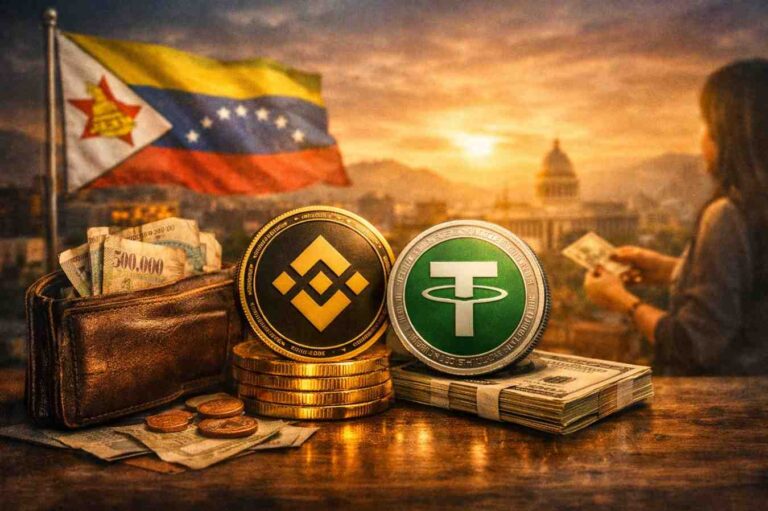
Venezuelans increasingly use Binance P2P and USDT as inflation and currency controls weaken the bolivar, pushing digital dollar demand higher.
A growing number of Venezuelans are shifting toward cryptocurrency platforms such as Binance to protect their savings. As the national currency bolivar degrades, they are purchasing USDT, a stablecoin pegged to the dollar. According to CriptoNoticias, USDT has gained approximately 16% in Venezuela’s peer-to-peer market in the last 30 days, reaching as high as 800 bolivars at times, from around 690 bolivars.
Why Are Venezuelans Turning to Binance for USDT?
The economic crisis in Venezuela is driving citizens and businesses to digital dollars. Rapid bolivar liquidity expansion and strict foreign exchange controls are limiting access to traditional dollars. Moreover, limitations on banking and caps on the amount of currency purchased are limiting availability in the formal financial sector.
Consequently, Binance P2P has become the preferred platform for many to purchase USDT. This platform is a direct trading platform between buyers and sellers without the involvement of traditional banking channels. Thus, the demand for USDT has been growing rapidly, and the price of USDT has also been climbing rapidly in bolivars.
Local media reports that the Central Bank of Venezuela (BCV) and the commercial banks are unable to satisfy the demand for dollars. Economist Hever Castro said that official dollar supply is still not enough. Furthermore, banks can turn off digital dollar services when quotas are reached, and users are unable to access them.
How Do Foreign Exchange Controls Affect Dollar Access in Venezuela?
Government regulations are also pushing cryptocurrencies. There are monthly and annual dollar limits on purchases. There are reports of up to 12,000 USD per person per year and 1,000 USD per month. These restrictions limit legal access to foreign currency.
Thus, businesses and citizens are moving to Binance and other P2P platforms. The platforms enable users to trade freely, leading to greater liquidity and volatility. In this system, the price of USDT is determined by the market demand and supply, not the official exchange rate.
Asdrúbal Oliveros, an economist, said that these restrictions are speeding up the transition to digital assets. With the traditional access being weakened, people are using stablecoins to store value and to make daily transactions.
Why Is USDT Becoming a Key Price Benchmark in Local Trade?
USDT is a stablecoin that is pegged to the USD. Its price in Venezuela, however, varies according to the local market. It may not necessarily be the official exchange rate established by the government.
This has led to USDT being used as a benchmark for pricing goods and services. The Binance P2P rate is now being used by many businesses, particularly informal traders, to set prices. This has created a benchmark for the digital dollar to be used for inflation adjusted pricing on a daily basis.
But, local markets are being distorted by price differentials. In Caracas, for example, exchange rates are sometimes as high as 1,200 bolivars to the dollar. This allows them to safeguard profits when volatility is high, but puts pressure on consumers’ costs.
How Is Inflation Reshaping Venezuela’s Digital Economy?
Venezuela still suffers from high inflation and currency volatility. The more bolivars in circulation, the less their value. Further, this drives digital assets as a more secure store of value.
In reality, USDT serves as a financial safety cushion for households and businesses. Individuals buy and sell bolivars for stablecoins in a hurry to prevent further depreciation. This action will further drive up demand for Binance P2P and other platforms.
Additionally, cash dollars are less available, which further drives the adoption of digital systems. As there are fewer alternatives, crypto platforms are becoming a necessity in financial life.
Is Venezuela Moving Toward a Crypto-Based Parallel Economy?
As USDT becomes increasingly popular, it is changing the way trade is conducted in Venezuela. Digital dollar values are increasingly tied to prices, wages and savings. This change is particularly noticeable in informal markets where rules of currency are malleable.
As a result, the bolivar is losing its role as the main unit of exchange. Rather, stablecoins are filling the void created by weak banking systems and tight controls. This change is creating a parallel financial system based on crypto platforms.
Overall, Venezuela’s economic situation is driving more people to Binance and USDT. The trend reflects the growing importance of digital assets in everyday financial activity in the country.

I am a crypto news writer focused on blockchain updates, market trends, and digital asset developments. I write clear and simple articles that help readers understand the fast-moving crypto world.