
Crypto markets monitor US Supreme Court tariff case closely as legal uncertainty over trade policy increases demand for decentralized assets.
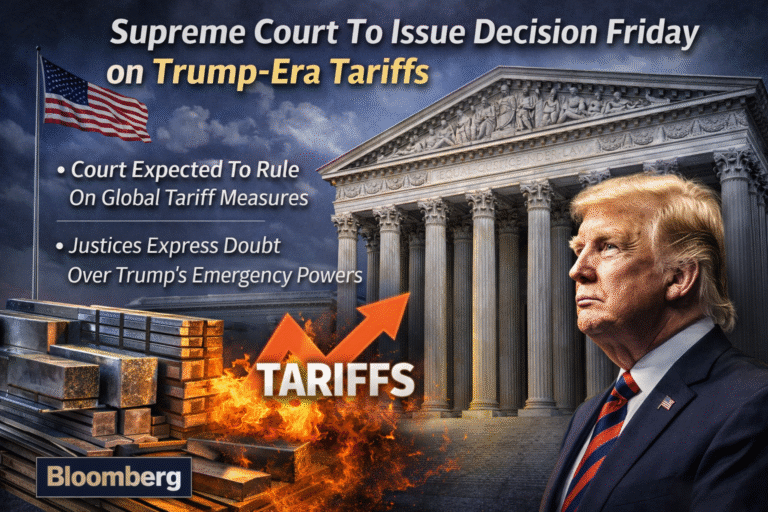
The US Supreme Court has set Friday as an opinion day, creating the first chance to rule on Trump-era global tariffs. Meanwhile, crypto investors are watching closely, as the outcome could cause the markets to become volatile and see renewed interest in borderless digital assets.
Supreme Court Scrutiny Adds Macro Risk for Crypto Markets
According to Bloomberg, the court is allowed to make a decision on tariffs imposed by President Donald Trump. These measures include April 2 “Liberation Day” tariffs, implementing levies ranging from 10% to 50% on the majority of imports. Additionally, duties went over to Canada, Mexico, and China regarding fentanyl trafficking issues.
According to Bloomberg, the U.S. Supreme Court has set Friday as an opinion day, which will mark the first opportunity for the court to potentially issue a decision on the global tariff measures introduced by Donald Trump. During oral arguments on November 5, a majority of the…
— Wu Blockchain (@WuBlockchain) January 6, 2026
In oral arguments, November 5, a majority of justices were skeptical. Specifically, they asked whether Trump had the authority of the International Emergency Economic Powers Act of 1977. Traditionally, the power of trade and taxation is in the hands of the Congressional authority and this raises constitutional concern.
Chief Justice John Roberts and others said the tariffs are reminiscent of taxes on Americans. Therefore, a number of justices raised the issue of whether congressional approval was necessary. This uncertainty has wider macro implications and goes beyond trade policy.
Crypto analysts point out that legal uncertainty in the area of US economic policy often leads to a higher demand for alternative assets. Historically, a player like Bitcoin and stablecoins is known to attract attention at times of regulatory or geopolitical instability. Consequently, traders are measuring the potential spillover effects.
Trump has publicly defended the tariffs, saying they are a necessary negotiating tool. He recently told House Republicans that presidents need the flexibility over trade measures. However, markets still find drawbacks with judicial signals looking unfavorable.
If the court rules against Trump, it would destroy an important economic policy. Moreover, it may cause billions of dollars in refunds to importers. Such an outcome may result in lower confidence in traditional policy tools, with a knock-on effect for the crypto narratives.
Crypto Seen as Hedge if Tariffs Are Overturned
A decision against the tariffs could lead to more short-term market variance. Equity markets can be quite abrupt in their reactions while currency markets rebalance their trade expectations. In such environments, there is often an increase in the volume of trading crypto assets.
Bitcoin is often touted as the hedge for political and monetary uncertainty. Similarly, stablecoins have the benefit of providing rapid cross-border settlement without the tariff cost. As such, traders might then look to digital assets as a form of capital preservation.
Conversely, a decision for Trump would increase the authority of the president over trade. This result may mean greater policy unpredictability in the long term. For crypto markets, there tends to be a persistent uncertainty supporting demand for decentralized options.
Legal experts state that the administration may be able to reimpose the tariffs through other laws. However, Section 232 or Section 301 processes are slower and more complicated. Meanwhile, the disputes between them may have an extended impact to the markets across the globe.
The court’s decision comes after a four-week recess, and had added suspense for investors. Importantly, however, the Supreme Court does not announce in advance which cases are to be decided. Therefore, markets are on watch going into Friday.
Crypto market players are also looking out for signals from regulators. A ruling against executive prerogatives might strengthen a government based on the rule of law. However, increased emergency powers might indicate concerns for future policy shocks.
Trade partners, such as China and Mexico, are closely monitoring. Depending on the outcome, there is the possibility of retaliatory measures being taken. Such situations usually drive up the demand for neutral script layers such as blockchain networks.

Bilal Hassan is a seasoned crypto journalist with over five years of experience covering blockchain, digital assets, and global fintech trends. His work focuses on market developments, regulatory shifts, and the evolving landscape of cryptocurrency adoption worldwide.