
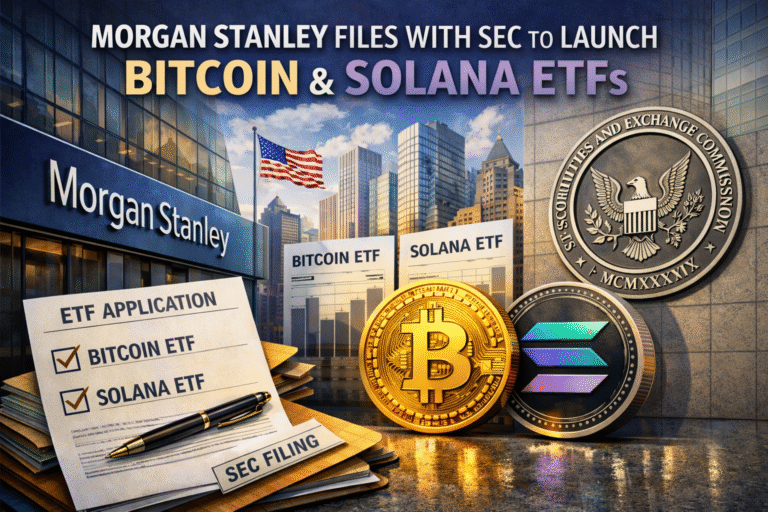
US investment bank Morgan Stanley seeks SEC approval for Bitcoin and Solana ETFs, signaling deeper Wall Street integration into regulated digital assets.
Morgan Stanley has filed with the US Securities and Exchange Commission to launch two crypto exchange traded funds. The filings feature a single fund tied to Bitcoin, and another fund tied to Solana. As a result, the involvement of Wall Street in regulated digital assets is continually growing.
Morgan Stanley Pushes Deeper into Regulated Crypto Products
According to Tuesday filings, the Morgan Stanley Bitcoin Trust and Solana Trust are passive vehicles. These products will store the underlying tokens directly and monitor performances net of expenses. Therefore, investors are exposed to price movements with no need to manage private keys or custody arrangements.
🚨BREAKING: Morgan Stanley, with $6.4T in assets under management, has filed an S-1 registration for the Morgan Stanley @Solana Trust ETF with the 🇺🇸 US SEC. pic.twitter.com/s4q9HKUTUq
— SolanaFloor (@SolanaFloor) January 6, 2026
The filings come as regulatory clarity improves under US President Donald Trump. As a result, digital assets are increasingly viewed as potential products by mainstream financial institutions. Previously, many banks shunned crypto, thinking it was both largely speculative and operationally risky.
In December, the Office of the Comptroller of the Currency relaxed restrictions on banks. Specifically, it enabled banks to serve as intermediaries for crypto transactions. Consequently, the gap between traditional finance and digital assets has become much smaller.
Many investors prefer to gain crypto exposure through ETFs versus directly owning a crypto asset. These products offer liquidity, ease of operation, and increased regulatory oversight. Moreover, ETFs minimize security risks related to self-custody and exchange failures.
Bryan Armour, an ETF analyst at Morningstar, commented on Morgan Stanley’s move. He said moving into a commoditized market implies client migration into proprietary ETFs. Therefore, late entry might still create rapid accumulation of assets.
Armour also mentioned that the involvement of banks gives the crypto ETF market credibility. As a result, other major banks could soon move in the same direction. This trend could usher in wider institutional adoption throughout global financial markets.
Over the past two years, crypto ETFs have grown exponentially in the United States. Since the approval of the first spot Bitcoin ETF, asset managers led issuance. All the while, banks were mainly custodians rather than active product sponsors.
Solana ETF Staking Feature Highlights Market Evolution
A notable staking feature is included in the proposed Solana Trust from Morgan Stanley. Under this structure a portion of SOL holdings may be staked. As a result, staking rewards would add to the fund’s net asset value over time.
This design reflects more general innovation in regulated crypto products. Moreover, it points out the ways blockchain features can fit into traditional investment structures. However, operational details will still be subject to regulatory approval.
The filings follow SEC approval of generic spot crypto ETF listing standards in mid 2025. Afterward, the market drastically grew. Existing spot Bitcoin ETFs currently hold over $123 billion in net finances.
Despite progress, the registration statements have been kept pending with regulators. Therefore, the securities cannot be offered or sold to investors. Additionally, Morgan Stanley has not announced launch dates or ticker symbols.
US banks are slowly changing roles in the crypto ecosystem. Previously prudent, many now seek to be active advisers rather than facilitators. As a result, competition can be intensified between banks and asset managers.
Industry observers are expecting these filings will impact overall market structure. Increased bank involvement could standardize compliance expectations. However, some argue that smaller issuers could face increasing competitive pressure.
At least for now, Morgan Stanley’s move signals confidence in regulatory momentum. It also sends a signal of acceptance of crypto as a permanent asset class. Adapting the Digital Assets ETF Ultimately, the expansion of ETFs could redefine the way institutions and retail investors access digital assets.
As approval decisions draw near, market participants will watch regulatory signals carefully. Any approval might further legitimize crypto investment products. Therefore, Morgan Stanley’s filings are a huge milestone for regulated digital finance.

Bilal Hassan is a seasoned crypto journalist with over five years of experience covering blockchain, digital assets, and global fintech trends. His work focuses on market developments, regulatory shifts, and the evolving landscape of cryptocurrency adoption worldwide.