
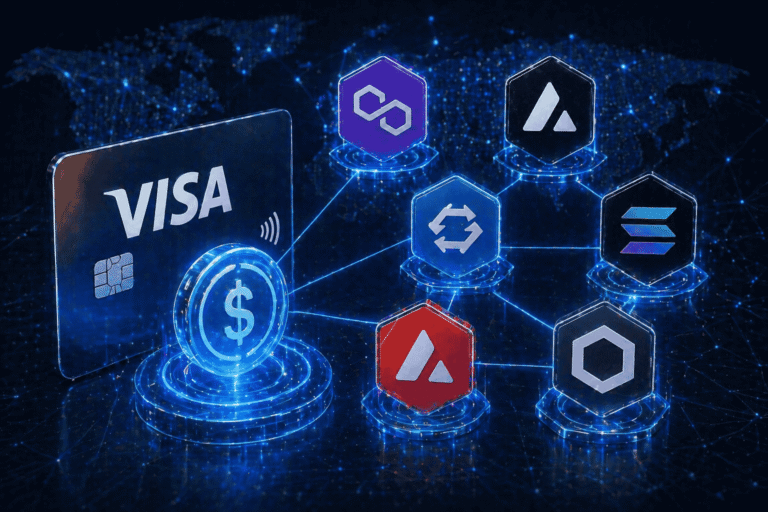
Visa adds Polygon, Base, Canton, Arc, and Tempo to stablecoin pilot, growing blockchain settlement options worldwide.
Visa has expanded its stablecoin settlement pilot to more blockchain networks. The company has added Polygon and four other chains. So, Visa is ramping up its collaboration with cryptocurrency payment networks around the world.
The trial began in 2023. This enables partners to make payments with stablecoins rather than banks. This means payments can be quicker and cheaper.
Visa said partners are now in a multi-chain world. They want more network choices for payments and liquidity. So, Visa expanded its support for multiple emerging blockchain networks.
The new networks are Polygon, Base, Canton, Arc and Tempo. This brings the total number of blockchains Visa supports to 9. This means it now has more settlement options.
Visa Adds Five New Blockchain Networks
Polygon is a fast and cheap network. It is popular for payments and e-commerce. So it is a good match for Visa’s settlement objective.
This week, Base joined the program. Base is supported by Coinbase and offers low fees. It’s therefore become a choice for stablecoin transactions.
Reading More: Stablecoin News: New US Proposal Targets Illicit Stablecoin Activity – Ledger Tribune
Canton was added for regulated institutions and private markets. The network provides enterprise users with privacy. So it could be suitable for banks and other financial companies.
Arc also participated in the extended pilot. Arc is an open Layer-1 blockchain developed by Circle. It is a programmable money and economic activity network.
The fifth addition was Tempo. The network is about fast and private stablecoin liquidity. As a result, it enables real-time payments.
Visa previously supported Avalanche, Ethereum, Solana and Stellar. Now there are 9 supported networks. So, the pilot is an indicator of multi-chain interest.
Visa’s Rubail Birwadker explained the decision. He explained partners want what is real. So Visa wants to support multiple blockchain ecosystems.
Stablecoins Move Beyond Early Experiments
Stablecoins are now becoming useful, Visa said. Previously, they were seen as experiments. But many companies now use them for international payments.
Use has been increasing over the last year. Stablecoins facilitate fast cross-border transfers. This allows companies to streamline treasury and settlement.
Visa has already piloted stablecoin services in several markets. This includes Latin America, Europe, Asia Pacific and CEMEA. So, it has a lot of experience with pilots.
It also recently launched USDC settlement. Stablecoin systems are now available to US banks and many card programs. As a result, blockchain finance is going mainstream.
Visa said over 130 card programs are now linked to stablecoins. These are in more than 50 countries. So, interest seems to be growing rapidly.
Partners See Bigger Role for Crypto Payments
Circle executive Nikhil Chandhok welcomed the partnership growth. He said Arc provides access to liquidity. So, it can enable instantaneous settlement around the world.
Jesse Pollak, founder of Base, also welcomed the move. He noted stablecoin payments may soon be mainstream. So, more people could use blockchain finance.
Eric Saraniecki of Digital Asset spoke about Canton. He said regulated institutions need compliant settlement tools. So Visa can connect traditional finance and blockchain.
Polygon Labs CEO Marc Boiron also welcomed the announcement. He noted Visa’s global presence provides scale. As a result, stablecoin settlement could be more viable globally.
Tempo executive Ani Narayan said real-time payments are useful. He said Visa’s involvement aids adoption. So, programmable payments could accelerate.
Visa Builds a Multi-Chain Future
Interoperability is still important, Visa said. There are different networks for different users globally. So, a single settlement layer is less complex.
The company seeks secure services for legacy and new systems. It wants security, scalability and reliability everywhere. As a result, blockchain payments could become more trusted.
In conclusion, Visa’s move highlights growing interest in stablecoins. Big firms now experiment with crypto for payments. So, digital payments may become more mainstream worldwide.

Bilal Hassan is a seasoned crypto journalist with over five years of experience covering blockchain, digital assets, and global fintech trends. His work focuses on market developments, regulatory shifts, and the evolving landscape of cryptocurrency adoption worldwide.