
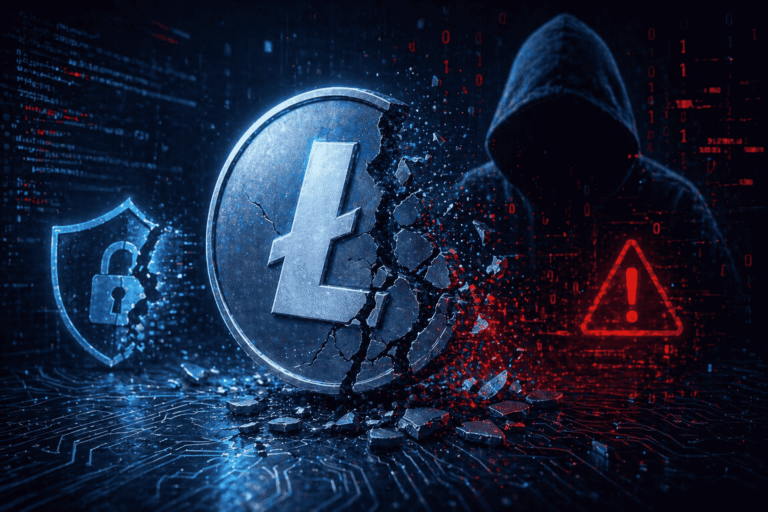
Litecoin fixes major MWEB privacy layer bug after 13-block reorg, reversing invalid transactions while keeping network stable and secure.
Litecoin faced a major disruption after a critical bug was exploited in its privacy layer. The problem was on MimbleWimble Extension Block or MWEB. But developers were quick to rectify the issue and normalcy was restored.
Zero-Day Bug Triggers Network Disruption and DoS Attack
The attack started when attackers found a zero-day exploit in the MWEB system. This vulnerability enabled old mining nodes to accept invalid transactions. Consequently, attackers could transfer coins out of the privacy layer to third-party platforms.
Litecoin update:
• A zero-day bug caused a DoS attack that disrupted major mining pools.
• Non-updated mining nodes allowed an invalid MWEB transaction allowing them to peg out coins to third party DEX’s
• A 13-block reorg reversed those invalid transactions — they will not…— Litecoin (@litecoin) April 25, 2026
In addition, the bug allowed a denial-of-service attack on large mining pools. These attacks temporarily halted normal mining activities. Thus, the network was temporarily unstable at the time of the event.
Read more: UK FCA Raids Illegal Crypto Trading Sites in Major Crackdown – Ledger Tribune
The main problem was the unpatched nodes that could not check transactions properly. These nodes accepted peg-out transactions, which are supposed to be rejected. This led to the production of invalid coins and their distribution to third-party decentralized exchanges.
Moreover, the attack demonstrated the dangers of using outdated software. The nodes that failed to update turned out to be weak links in the network. Thus, developers encouraged all operators to upgrade as soon as possible.
Litecoin Executes 13-Block Reorganization to Fix Issue
To fix the issue, the Litecoin developers initiated a reorganization of the 13-block chain. This procedure eliminated invalid transactions in the blockchain. It covered blocks between 3,095,930 and 3,095,943, lasting about 32 minutes.
Notably, legitimate transactions at this time were not impacted. The fraudulent transactions were only reversed and not included in the main chain. Consequently, user funds were not at much risk.
Moreover, the network stabilized soon following the reorganization. The vulnerability is now completely patched, developers confirmed. Thus, the system is functioning normally once again.
Nonetheless, there were cross-chain platforms that suffered minimal losses. As an illustration, systems that were linked to the outside networks were exposed during the attack. In some cases, it is reported that it has lost approximately $600,000.
Despite this, overall market reaction remained calm. The price of Litecoin remained close to $56, with a slight 1% decrease.
Patch Released as Network Returns to Normal Operations
After the incident, developers published a security update to address the vulnerability. Node operators were advised to upgrade to Core version 0.21.5.4 immediately. This update will provide complete safeguards against such problems.
Interestingly, there are reports that the bug might have been detected earlier. In March 2026, the code was updated, suggesting a potential pre-attack private patch. But those nodes that did not update were still at risk.
This scenario underscores the significance of software updates in blockchain networks in a timely manner. Any minor delays can pose significant security threats. Therefore, regular maintenance is essential for network safety.
Simultaneously, the incident demonstrates the rapidity of blockchain systems in reacting to threats. The reorganization was successful and eliminated harmful transactions without harming the network. Therefore, Litecoin proved to be resilient to pressure.
Finally, there was a brief but severe disruption due to the Litecoin MWEB bug. Nevertheless, prompt intervention by programmers saved the situation and safeguarded users. Therefore, the network continues to operate securely after the fix.

Bilal Hassan is a seasoned crypto journalist with over five years of experience covering blockchain, digital assets, and global fintech trends. His work focuses on market developments, regulatory shifts, and the evolving landscape of cryptocurrency adoption worldwide.